
Choose a city hotel when the place outside your door is the reason you are travelling, and choose a resort when the property itself is the trip. That is really the whole decision. Everything else – fees, transfer time, half-board versus à la carte – follows from which of those two you are booking for.
The honest version is that neither option is better. A resort in a city you planned to explore means paying for pools you never swim in and a shuttle for every dinner. A city hotel in a beach destination means fighting for towel space and finding nothing to do on a rained-out afternoon.
Get it wrong and you lose money and time, not just comfort. Getting it right means most of your planning disappears, which is the quiet benefit people rarely mention.
Table of Contents
- 1How to Choose Between a Resort and City Hotel at a Glance
- 2Location and Access to Everyday Attractions
- 3Atmosphere, Privacy, and Entertainment
- 4Amenities and In-Resort Convenience
- 5What to check from the listing before you pay
- 6The third option nobody mentions
- 7Food, Drinks, and All-Inclusive Value
- 8Labels blur more than the definitions suggest
- 9Cost, Fees, and the Shape of Your Vacation
- 10How to Choose Between a Resort and City Hotel for Your Trip Style
- 11Which Should You Choose?
- 12Frequently Asked Questions
- 13Is a resort better than a city hotel for a first trip?
- 14Which is better for families with children?
- 15Is a city hotel cheaper than a resort?
- 16Which option is better for a short weekend getaway?
- 17How do I choose between a resort and city hotel for work?
- 18What should I check before booking either type of accommodation?
- 19Make Your Choice by Starting with the Trip
How to Choose Between a Resort and City Hotel at a Glance
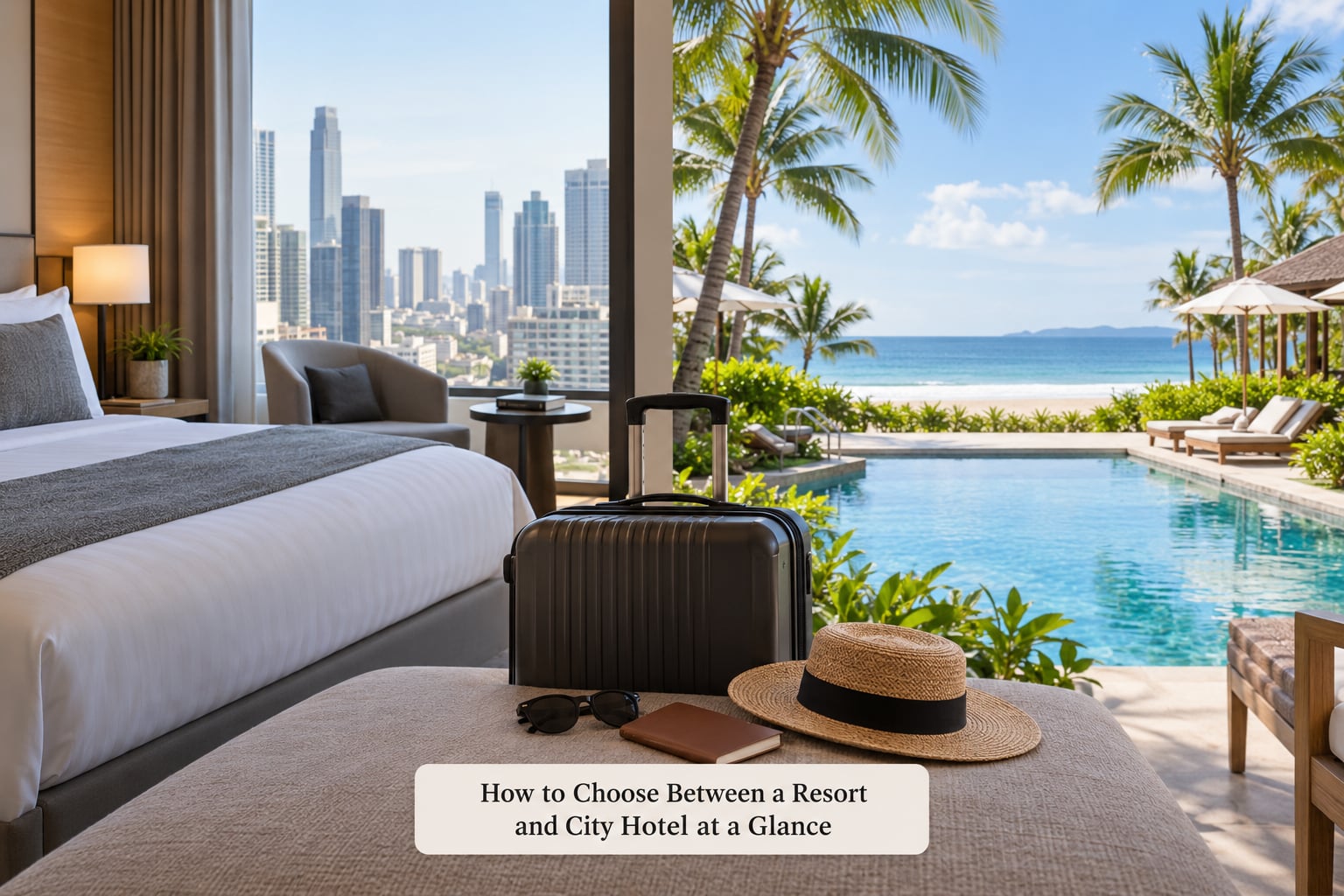
Resorts win when your trip is about slowing down and everything happening on site. City hotels win when the trip is about going out. That difference shows up in almost every practical detail.
| What to compare | City hotel | Resort |
|---|---|---|
| Ideal traveller | Anyone whose plan involves leaving the room | Travellers whose plan is to stay on site |
| Location | Walkable or transit-linked district | Secluded, coastal, rural or mountainside |
| Atmosphere | Local, urban, part of the neighbourhood | Contained, staffed, lightly scripted |
| Typical stay | One to four nights | Five nights to a week or more |
| On-site amenities | Gym, small bar, sometimes a rooftop pool | Pools, spa, kids club, beach, multiple restaurants |
| Dining | You pick and pay per meal nearby | Half-board or all-inclusive often included |
| Getting around | Walk, metro, taxi, short rides | Shuttle, excursions, sometimes a long transfer |
| Use of leisure time | Spent out in the destination | Spent in the property’s own facilities |
| Value shape | Nightly rate plus variable extras | Higher daily rate, more of it bundled |
| Watch out for | Street noise, small rooms, nowhere to unwind | Boredom on quiet days, pricier extras off site |
The row that surprises people most is stay length. A three-night city trip in a large resort wastes two days on transfers and settling in. A week of nothing to do in a city centre is a different kind of waste.
Location and Access to Everyday Attractions
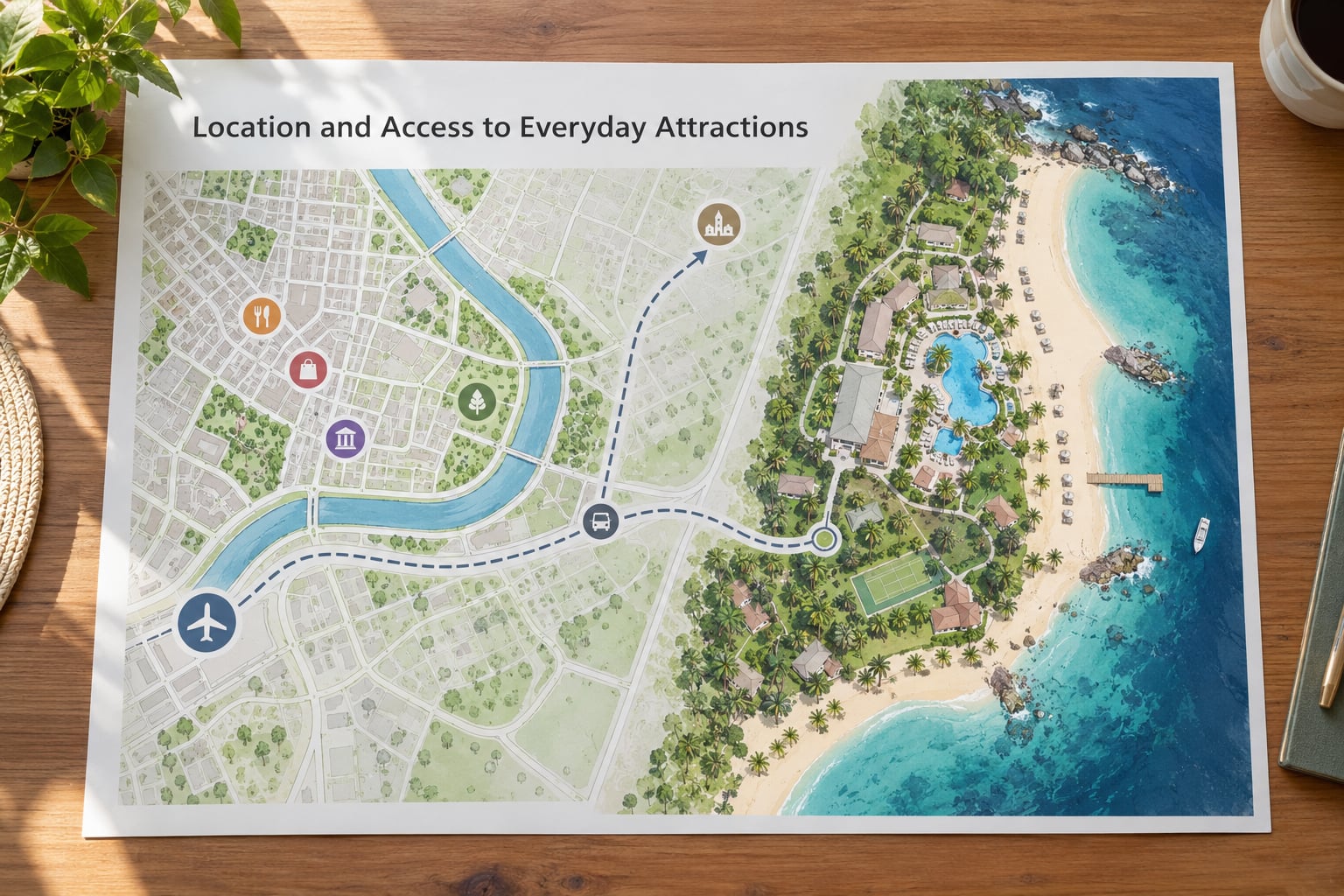
A city hotel puts you within walking distance of restaurants, museums, shops, transit and nightlife. That is the entire product. You can walk back at one in the morning with a paper bag of something from a place that closed at eleven.
A resort trades that for space, quiet and predictability. You get a beach or a hillside, several pools, and staff who already know your order on day three. The trade-off is that anything independent is behind you, usually behind a shuttle.
Here is how to choose between a resort and city hotel on location specifically: open a map, pin every place you genuinely plan to visit, then measure both properties to those pins. If the honest answer is three evenings at restaurants, two museums and a market, stay central. If it is a beach and one excursion you may or may not take, distance matters much less.
Then check transfer time, because it eats more trip than most travellers expect. A resort forty minutes from the airport costs you most of a day on arrival and again on departure. People regularly turn a seven-night holiday into five usable nights and describe it as a good time anyway.
Travellers on forums ask about this constantly, and their answers rhyme: two or three nights leaves no room for complicated transfers or experimental locations. On a short trip, proximity wins by default.
Atmosphere, Privacy, and Entertainment
A resort runs on a rhythm. There is a morning activity, an afternoon slot, a kids club session, a themed dinner, a show. Nothing about that is bad, but nothing about it is spontaneous either.
A city hotel has no rhythm at all. That is the appeal and the annoyance. Some nights you stumble back from a great neighbourhood at midnight; some nights you order in because it is raining and the room has a desk and a decent chair.
Privacy runs the same split. Resort rooms face gardens or sea rather than a shared corridor, and adults-only properties remove the family holiday noise entirely. City hotels vary wildly here – a top-floor room on a courtyard can be silent, a room over a bar on a weekend will not be.
Now the downsides nobody sells you. Big resorts get boring fast: the activities thin out, the restaurant rotation repeats, and by day four you are inventing plans. On the flip side, a “luxury” city hotel can deliver a small room, thin sound insulation and no pool, which is just a commute with a breakfast.
Match this to your own habit. People who enjoy a planned day do well at a resort. People who like deciding at nine in the morning do not.
Amenities and In-Resort Convenience
This is where the gap is widest. A city hotel gives you a gym, maybe a small bar, sometimes a rooftop pool, and full access to the city’s restaurants, galleries and shops – all of which are better and cheaper than most hotel equivalents.
A resort can put a kids club, a spa, four pools, a beach and three restaurants inside twenty minutes’ walk of your room. Families pick resorts for reduced friction, not luxury. Pools that are close, food that is close, and childcare that means the adults get an actual afternoon.
Business travellers get the reverse deal. Reliable Wi-Fi, a proper desk, printing, a working lobby and a short journey to the office matter more than a horizon. City hotels usually win that category outright, though check the Wi-Fi before you commit rather than after.
One detail changes the maths more than readers expect: room category. A garden villa with a private pool, or a room actually facing the sea rather than the car park, is not a small upgrade. It is the thing you will actually use every day. Read the specific room name, not the property name.
What to check from the listing before you pay
Five checks resolve most disappointments before they happen, and none of them take long.
Map your real itinerary first, then measure both properties to it, including walking time rather than drive time. Second, check door-to-door transfer time including baggage, not the airport-to-lobby estimate in the brochure. Third, read reviews of the exact room category you are booking, not the best one in the building. Fourth, confirm what the rate includes and what gets charged separately. Fifth, look at the cancellation terms before anything else.
There is a sixth, informal one that catches a lot of people. Type the property name into a map and look at what surrounds it. A resort marketing itself on quiet beaches with the nearest town an hour away is telling you something useful, whatever the description says.
The third option nobody mentions
The resort-versus-city-hotel framing leaves out some options that fit plenty of trips better than either.
A self-catering villa or aparthotel gives you resort-style space and a kitchen with none of the on-site programme. A lodge or an eco stay in a national park is a resort in spirit with the itinerary set by the place. A river cruise moves the accommodation itself, which is the opposite problem and sometimes the right one.
They are worth a look when your trip is longer than a week, when you want to cook occasionally, or when the destination is remote enough that a self-contained property beats a long daily commute.
Food, Drinks, and All-Inclusive Value
Food is the single largest difference in how the two feel. A city hotel usually gives you a room and maybe breakfast. Everything else is a fifteen-minute walk and your own decision, which means you eat what the neighbourhood is good at.
A resort packages meals in, usually across two or three restaurants plus a buffet. All-inclusive goes further and folds drinks and some activities into the same rate. Guests who use most of the facilities often see that as the better value at the end of the week.
It is not automatically cheaper, though. That is the misunderstanding worth correcting early. If you would have eaten at three restaurants a night anyway, and the resort charges specialty dining or excludes premium drinks, the saving can evaporate quietly.
Compare total spend, not headline rate: your probable meals and drinks outside versus what the package includes, plus any extras the resort sells at a markup. Forum complaints about resorts usually trace back to one word – excursions. Off-property activities priced well above the same thing booked from town erode an all-inclusive saving quickly.
Labels blur more than the definitions suggest
A resort is not a formal category with a fixed checklist, and the label is used loosely in both directions. Plenty of city hotels have a rooftop pool, a spa and a kids club and market themselves as resorts. Plenty of resorts are urban, with a business district fifteen minutes away.
Read the facilities list rather than the category on the page. What matters is whether the on-site amenities will fill your days, not what the property calls itself.
Cost, Fees, and the Shape of Your Vacation
Cost only means something per trip. Compare the full amount for the exact nights you are travelling: room rate, taxes, any destination or resort fee, meals, drinks, activities, parking, transport and transfers.
Resort and destination fees are the detail that catches people. They are mandatory charges, not optional line items, so you cannot decline them at check-in. They belong in your comparison from the start, not in a surprise at the desk.
Prices and fee policies vary by destination, property and season, and they change. Read the official property terms rather than trusting the headline number on a listing, and check what the rate actually includes before comparing it with another one.
As for timing, book early when a fixed local event drives demand – a festival, a conference, a school holiday period, a peak ski week – and book late when you are happy to be flexible. There is no universal best day to book, and anyone offering one is guessing.
How to Choose Between a Resort and City Hotel for Your Trip Style
Turn your priorities into a filter. If your list reads pool, spa, kids club, privacy, slow mornings, you are looking at a resort. If it reads museums, food, nightlife, meetings, short visits, walk to the tram, you are looking at a city hotel.
When it is genuinely mixed – a long trip that needs both – score a shortlist of two or three properties across five columns: location, room, transportation, meals and activities. Mark the ones you cannot compromise on, and pick the property that satisfies the most of those, not the one that wins the total.
Be honest about the room you will actually be assigned. Reviews of the property’s best category say very little about a side-facing room in the annexe.
Which Should You Choose?
Choose a city hotel for a first trip to a city, a business trip, a weekend break, a layover of a night or two, a food-focused trip, and anything with museums or nightlife in the plan. Choose a resort for a family holiday where the pool and the kids club solve a real problem, a honeymoon or anniversary where privacy and space are the point, a wellness trip, a winter-sun week, or a solo traveller who wants the logistics handled for them.
Experienced resort travellers usually want a longer stay and a planned daily rhythm. Experienced city travellers usually want independence and a short, ambitious itinerary. Neither habit transfers neatly.
The two-option checklist: write down the two or three experiences that must happen, confirm which neighbourhood or resort area puts you closest to them, compare total cost and door-to-door travel time, and then book the option that forces the smaller compromise.
If your dates or the weather are still uncertain, book something with free cancellation. Flexibility is worth more than a slightly better rate when you cannot control the thing that would make the trip good.
Frequently Asked Questions
Is a resort better than a city hotel for a first trip?
Neither is better – it depends on whether the destination or the property is the main event. For a first visit to a city, stay central so you can walk to things and change your mind each day. Choose a resort instead when the trip is a holiday from the property itself: a pool, a beach, a kids club, or a week of doing very little.
Which is better for families with children?
Resorts usually win for families, and for practical reasons rather than luxury. Pools, kids clubs, easy dining and rooms close together remove most of the daily logistics, so nobody is negotiating about what to do next. A city hotel suits families whose trip is built around attractions, museums and a packed itinerary, provided you can find one with a pool or nearby apartments.
Is a city hotel cheaper than a resort?
It depends on the trip, not the label. A city hotel charges a nightly rate and lets you spend the rest on meals and transport. A resort bundles more into a higher daily rate. A city stay wins when you were planning to eat out and go out anyway. A resort wins on value only if you actually use its pools, restaurants and included activities.
Which option is better for a short weekend getaway?
A city hotel, in most cases. Two or three nights leave little room for long transfers or settling into a large property, and a weekend rewards easy access to restaurants and things worth seeing. Pick a resort only when the accommodation itself is the destination – a spa retreat, a remote lodge, or somewhere the evening plans are on site.
How do I choose between a resort and city hotel for work?
Start with the location of your meetings and the reliability of the connection, not the pool. City hotels near a business district usually give you shorter journeys, proper desks, printing and late food nearby. Resorts suit longer work stays where the schedule is yours. Check Wi-Fi reviews for the exact room category before booking either, because it varies more than the star rating suggests.
What should I check before booking either type of accommodation?
Map your actual itinerary against both locations, check door-to-door transfer time including baggage, read reviews of the exact room category you are booking rather than the best one in the building, confirm what the rate includes and what is charged separately, and check cancellation terms. Those five checks resolve most disappointments before they happen.
Make Your Choice by Starting with the Trip
Write down the two or three experiences that have to happen. A beach morning, a specific museum, a birthday dinner that needs a good neighbourhood. Pin them on a map, then look at which property puts you closest without turning every day into transport.
After that, compare total cost rather than nightly rate, including fees, meals and door-to-door travel time, and pick the option that forces the smaller compromise. Book cancellable when the dates or the weather are not settled, because flexibility is worth more than a small saving you cannot use.
That is how to choose between a resort and a city hotel without overthinking it. Start from the trip, not from the property type.