To stay safe in a hotel room alone, engage every lock the moment you walk in: deadbolt, swing bar, peephole check. Then add one layer of your own, a portable door lock or a door stop alarm, and never open the door to anyone you have not first verified with the front desk. Ten minutes of work covers almost everything that can go wrong.
Here is the honest bit first. Almost every hotel room you will stay in is fine. Hotels are full of strangers with keys, closed-circuit cameras in lobbies and staff who check on guests by policy, so the realistic threat is opportunistic and clumsy rather than targeted. Everything below is about edge cases and about the part of your brain that stays awake at midnight listening to a corridor.
Regulars on travel forums say the same thing in different words: the fear is usually worse than the risk, and a ten-minute routine buys back enough calm to actually sleep. That is the whole goal here.
Table of Contents
- 1What You Need
- 2Step-by-Step
- 31. Confirm the Room Before You Enter
- 42. Check the Door, Windows, and Entry Points
- 53. Make the Room Safer When You Arrive
- 64. Protect Your Belongings and Personal Information
- 75. Plan for Emergencies and Communication
- 8Common Mistakes
- 9Quick Solo-Travel Safety Tips
- 10Frequently Asked Questions
- 11What is the safest floor to request in a hotel room?
- 12Should I use a door wedge or security alarm in a hotel room?
- 13What should I do if someone knocks on my hotel room door?
- 14Is it safe to leave valuables in a hotel room while I go out?
- 15What should I do if I notice someone outside my hotel room at night?
- 16How can I make a hotel room safer when I am travelling alone?
What You Need
Gather these before you arrive and keep them in one place, because half of hotel room safety is being able to find something in the dark.
- The hotel address and phone number, saved in your phone and written on paper. You will use it to verify visitors.
- A charged phone with a local SIM or eSIM so emergency calls actually connect.
- Photo identification plus a copy of your passport kept separately from the original.
- A flashlight, because the bathroom and the back of the wardrobe have no overhead light in plenty of rooms.
- A portable door lock or a door stop alarm, if the hotel permits portable devices.
- One trusted contact at home who knows where you are and has your itinerary.
The device question comes up constantly, so here is what each one actually does. Nearly all of them cost about the same as a takeaway dinner, and only one of them is worth arguing about.
| Device | What it actually does | When it earns its place |
|---|---|---|
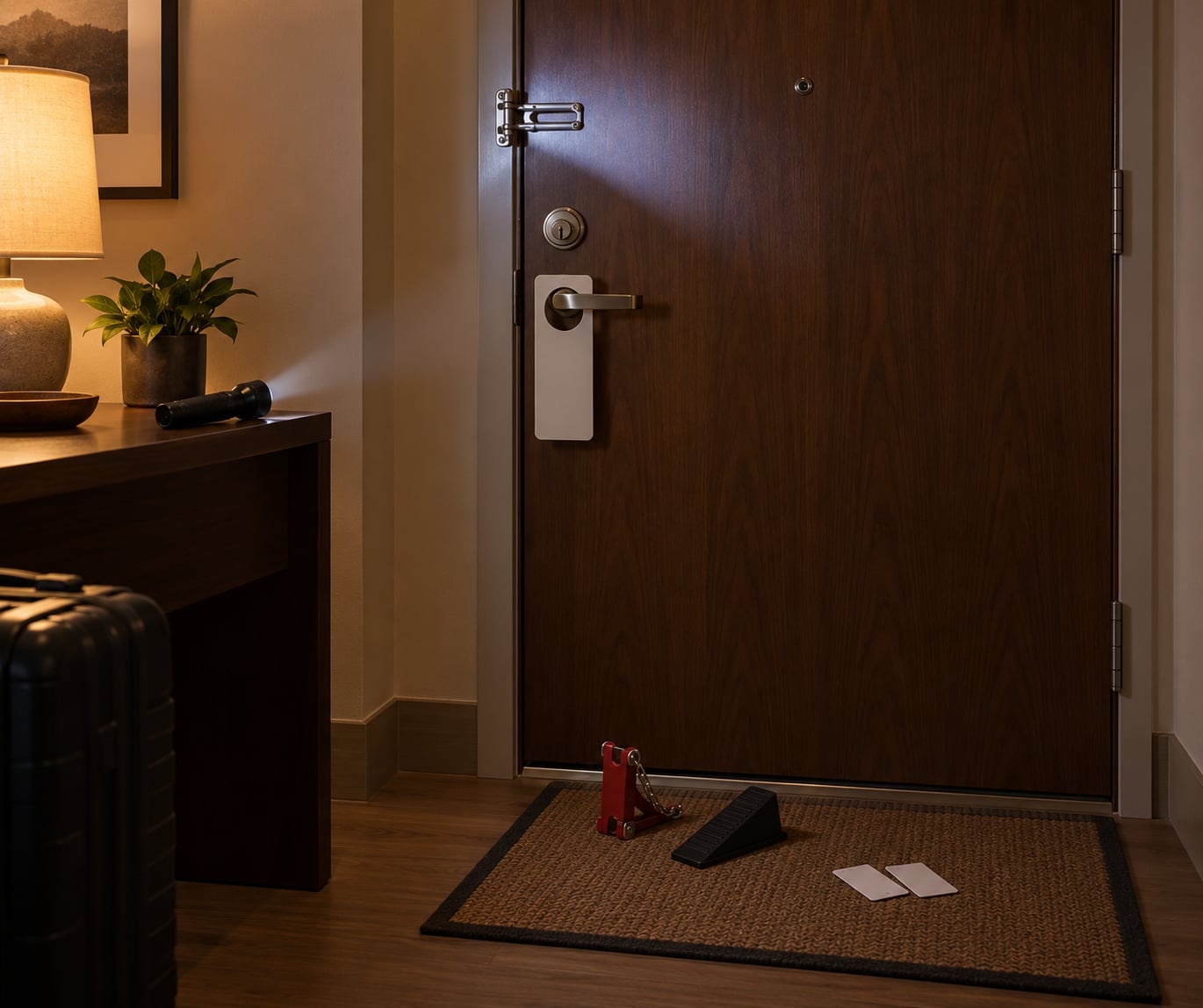
| Door stop alarm | Wedges the door and screams if the handle is moved | Your default choice overnight, especially in an unfamiliar city |
| Portable door lock | Physically blocks the door and releases in one motion | Any time you are out of the room for hours and need to get back in fast |
| Rubber wedge | Blocks the door with no alarm, no release mechanism | Only if you accept that it can block your own escape in a fire |
| Peephole cover | Stops anyone looking in at you | Long stays where you keep the same room for weeks |
| Personal alarm | Makes noise you control, from your pocket | Late-night walks from the hotel to a bar or a late train |
| In-room safe | Hides passports, cards and spare cash | Use it, but set a code you will actually recall tomorrow |
The wedge is the odd one out. Travelers argue about it constantly, and the consensus is fair: a wedge you cannot pull in a hurry is a real problem if the building is on fire. The portable lock wins on the same ground, because you can release it in seconds with one hand.
Step-by-Step
Run this sequence once on arrival, then a shortened version every time you come back to the room after dark. It takes about ten minutes the first time and ninety seconds after that.
1. Confirm the Room Before You Enter
Compare the number on your key card with the number painted on the door frame before you turn the handle. Mismatches happen, usually from a software glitch at the front desk, and walking into the wrong room at midnight is its own unpleasant surprise.
Look at the door before you open it. A scratched frame, a bent strike plate, a latch that sits proud of the jamb, or a security chain hanging loose rather than screwed in are all reasons to walk straight back to reception and ask for another room. You are not being fussy; you are describing damage you can see.
2. Check the Door, Windows, and Entry Points
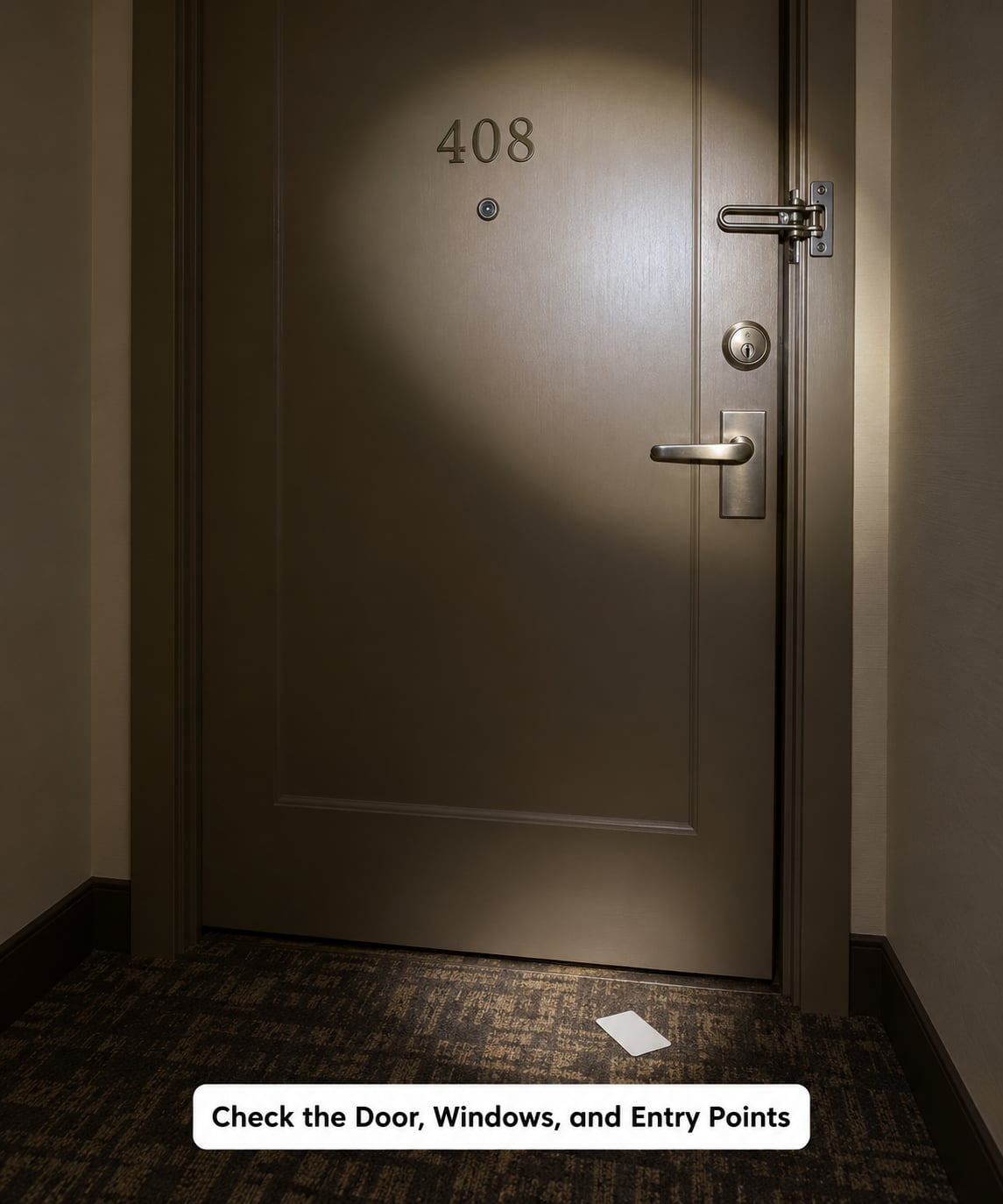
Shut the door, engage the deadbolt, and pull the swing bar until it seats properly. Then open it again and close it hard. If it latches softly, on its own, the latch is not catching and someone can shoulder it open. Report that tonight rather than assuming someone else will.
Run the rest of the room. Open the window and the balcony door and test their latches. Check whether the window opens far enough to climb through, because it should not. Look at the wall shared with the next room, the adjoining or connecting door, the bathroom vent, any fixed mirror that looks odd to your eye, and the space under the bed. Experienced flyers on r/flightattendants make a habit of checking the adjoining door and the windows first, because they have seen what a hurried housekeeping check looks like.
3. Make the Room Safer When You Arrive
Now put your own layer on. Set the door stop alarm or portable lock, and check it by pulling the handle yourself. If the device fails to hold, you have found a problem while you are still awake and dressed.
Hang the Do Not Disturb sign on the handle. It works in two ways: it discourages housekeeping from knocking, and it tells anyone in the corridor that you are in and awake. Two more tricks that cost nothing come from solo travelers themselves. Ask for two key cards at check-in, which is normal and unremarkable, and keep the second one in your bag so the room looks like it has someone joining you.
Never open the door to an unexpected visitor without verification. If someone claims to be room service, take their name, say you will call the front desk, and actually call it on the room phone. Staff will confirm whether the order exists. If they cannot, you have your answer and you stay where you are. Elevator technicians, maintenance workers and maintenance scams all rely on you opening first and asking later.
And do not announce your floor or room number out loud in the lobby, on the phone in the lift, or online. Say the hotel name and nothing more.
4. Protect Your Belongings and Personal Information
Split your valuables across two bags rather than trusting one hiding place. Passport, cards and a spare phone in the room safe; laptop, charger and a change of clothes in your day bag. A thief who takes one does not get the trip.
Set the safe code as something memorable in the moment, a date or a repeated number, then write it on a piece of paper and put that paper inside the bag in the safe. It sounds absurd until you have stood in a hotel room at midnight unable to open it. If you genuinely cannot recall the code, call the front desk and ask them to open it in front of you with your ID, then set a new one. Forgetting is common, and there is no version of this where guessing helps.
Keep your key card on you, not in a bag you leave on a chair. When you leave the room, take the safe key, the passport and one payment card with you and leave the low-value items behind. Nothing in a hotel room is worth chasing an intruder for.
5. Plan for Emergencies and Communication
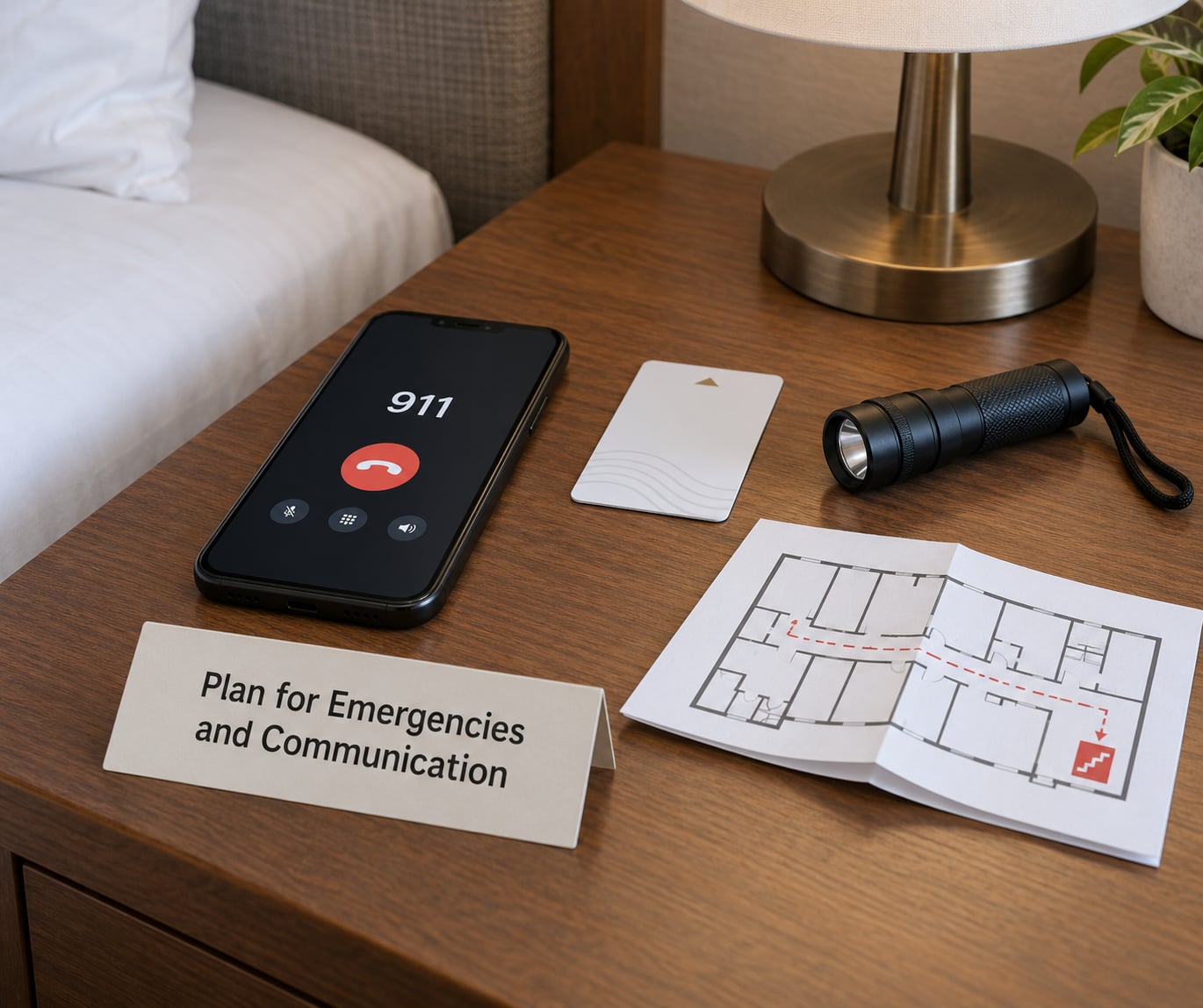
Before anything goes wrong, find the two nearest exits from your floor and walk them once. Note where the fire stairs are and where the lift lobby turns. Keep your room key and your shoes by the bed, because an evacuation at three in the morning is not the moment to hunt for either.
Save the local emergency number before you need it. It is 112 across most of Europe, 911 in the US and Canada, 999 in the UK, and 000 in Australia; many countries accept more than one of these. Ask the front desk when you check in and write the answer down. Set your phone to share live location with your trusted contact, and tell that person your hotel name, your room number and when you expect to check out.
Know what happens in the first thirty seconds if you hear your door being tested. Make noise, loudly, so anyone in the corridor knows a guest is awake and alert. Do not open it, and do not stand in the room announcing yourself. Turn the deadbolt if it is not already set and call the front desk or the local emergency number from inside.
If you come back and the door looks open, if a key card is in an unusual place, or if luggage has been moved, do not step further inside and do not confront anyone. Leave, find a member of staff, and ask them to come with you. Report it straight away, in writing if you can, and keep the incident report reference. Travelers who have had belongings disturbed while asleep are generally advised to report promptly to hotel management and request a formal investigation, because that paper creates a record and forces a room change.
You will also want a script for the front desk, because asking for a move is far less awkward than you imagine. Keep it short: I am travelling alone and would feel more comfortable on a different floor, away from the lift. Staff hear this constantly. Ask for a room away from connecting doors, and if you want it, ask someone to walk you up to the room or stand in the corridor while you check it inside, which is a request r/flightattendants makes regularly and that almost no traveler ever thinks to use.
Common Mistakes
Leaving the door ajar for a delivery or a friend. A propped door is an unlocked door. Close it and use the deadbolt every single time.
Treating the in-room safe as secure enough on its own. It protects against a rushed thief, not against a determined one. Split your valuables and carry the essentials.
Saying you are travelling alone. It changes how strangers treat you and how staff handle your room. Ask for two key cards and let people assume what they like.
Accepting a room without checking the lock properly. Pull the door hard after closing it. A door that latches without a key is not securing you.
Posting your room number or hotel on social media. Live location apps are for one trusted person, not for a public feed.
Relying on a Do Not Disturb sign alone. It is a courtesy, not a lock. Pair it with the door stop alarm and the deadbolt.
Isolating yourself with nobody aware you are there. If nobody knows where you are staying, a small problem stays small for a very long time.
Quick Solo-Travel Safety Tips
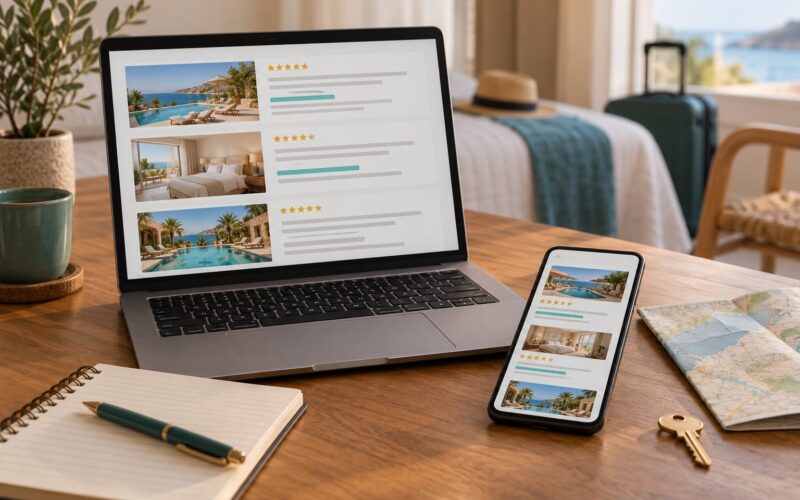
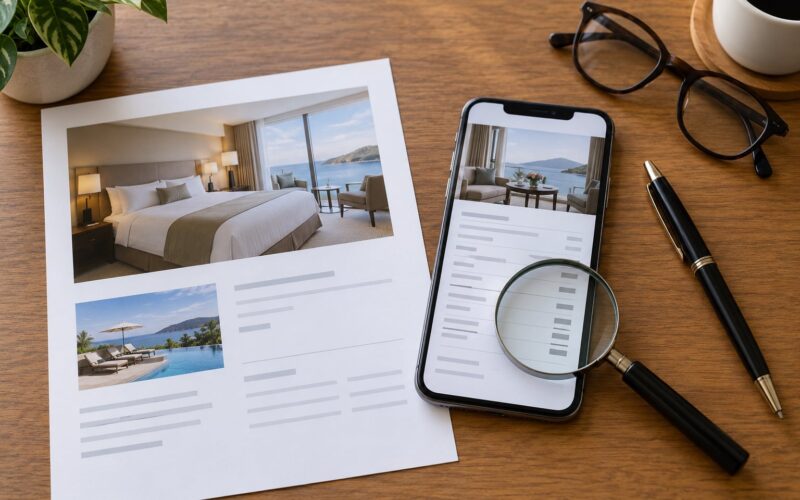
Read recent reviews with an eye for the specific, not the glowing. Comments about lighting, staff at night and the walk from the station tell you more than the star rating.
Choose a property with a staffed desk around the clock, and confirm how you will get in after a late arrival before you book, not at midnight at the gate.
Take the well-lit route from the taxi or the station, even if the short way looks tempting. Keep your phone in your hand rather than your pocket for that last block.
Trust the feeling that something is off, and act on it by leaving rather than investigating. Nobody has ever regretted getting out of a situation early.
Most of this list skews toward women, and that is a real gap. Solo men and LGBTQ+ travelers should think about the same levers from the other side: check-in times that put you in the lobby with other guests, avoiding a room at the end of a dead-end corridor, not walking back from a late venue alone, and having a plan if a stranger outside the hotel is persistent. Trust your gut applies to everyone.
Hostels, guesthouses and private rentals need a different version of this. There is usually no deadbolt, so your portable lock, your bag and your route home matter more. Get a locker, keep documents on you, and check the exterior entry points on arrival.
Frequently Asked Questions
What is the safest floor to request in a hotel room?
Above the second floor and below the seventh is the usual request. Lower floors are easier to reach from outside, while above roughly the seventh floor fire crews may not be able to reach a window with an extension ladder. Within that range, ask for a room away from lifts, stairwells and connecting doors, and avoid ground-level and rooms that open onto a fire escape.
Should I use a door wedge or security alarm in a hotel room?
An alarm door stop or portable door lock is the better choice. It warns you the moment the handle moves, and a portable lock releases in one motion if you need to leave quickly. A plain rubber wedge buys no warning and can block your own escape during a fire evacuation. Check that your hotel allows portable devices before you pack one.
What should I do if someone knocks on my hotel room door?
Do not open it, and do not use the peephole to announce you are there. Ask who it is and what they want through the door. If it is room service, take their name, close the door, and call the front desk on the room phone to confirm whether the order exists. If they cannot confirm it, stay inside and report it.
Is it safe to leave valuables in a hotel room while I go out?
Never everything, and never the originals. Keep your passport, spare payment card and a backup phone with you, and use the in-room safe for the rest. Set a code you will remember, write it on paper, and put that paper in a different bag than the valuables. On return, check the room before unpacking anything so problems are noticed early.
What should I do if I notice someone outside my hotel room at night?
Stay calm and do not open the door. Lock the deadbolt, switch on a light so it is visible from the corridor, and call the front desk or the local emergency number from inside the room. If you hear the door handle being tested, make noise so it is known you are awake. If you return to find the door open, do not enter further; find staff and ask them to come with you.
How can I make a hotel room safer when I am travelling alone?
Engage the deadbolt and swing bar on arrival, test the door by pulling it hard after closing, then add a door stop alarm or portable door lock. Inspect the window and balcony latches, the adjoining door and the bathroom vent. Keep your phone charged on a local network, save the emergency number, and leave live location sharing with one trusted contact.
Start with the deadbolt and the door stop alarm, then spend five minutes checking the latch, the window and the adjoining door. Everything after that is refinement.