A hotel that confirms more reservations than it has rooms is overbooking, usually on purpose to cover expected no-shows, sometimes by accident when booking systems fail to sync. When you arrive with a confirmed reservation and there is no room, you have been walked. Knowing how hotel overbooking works, and what to do at the desk in the first ten minutes, is the difference between a solved problem and a night spent hunting for a hotel at midnight.
This guide covers both halves: the property-side math that creates the oversell, and the traveler-side response, step by step, for guests in the US, the UK and the EU.
Table of Contents
- 1What You Need
- 2Step-by-Step: How Hotel Overbooking Works and What to Do
- 3How hotel overbooking works behind the scenes
- 41. Confirm exactly what the hotel has on record
- 52. Contact the hotel directly and document the request
- 63. Ask the hotel to honor the confirmed reservation
- 74. Request a room elsewhere rather than a vague referral
- 85. Escalate through the booking channel or card issuer if needed
- 96. Preserve evidence and keep the trip moving
- 10Common Mistakes
- 11Frequently Asked Questions
- 12Can a hotel refuse to honor a prepaid reservation because it is overbooked?
- 13What is a hotel walk and how does it work?
- 14Must an overbooked hotel pay for transportation to another hotel?
- 15What is the difference between a prepaid-refundable and prepaid-nonrefundable booking?
- 16Can I get money back if the hotel overbooks my reservation?
- 17Conclusion: What to Do First
What You Need
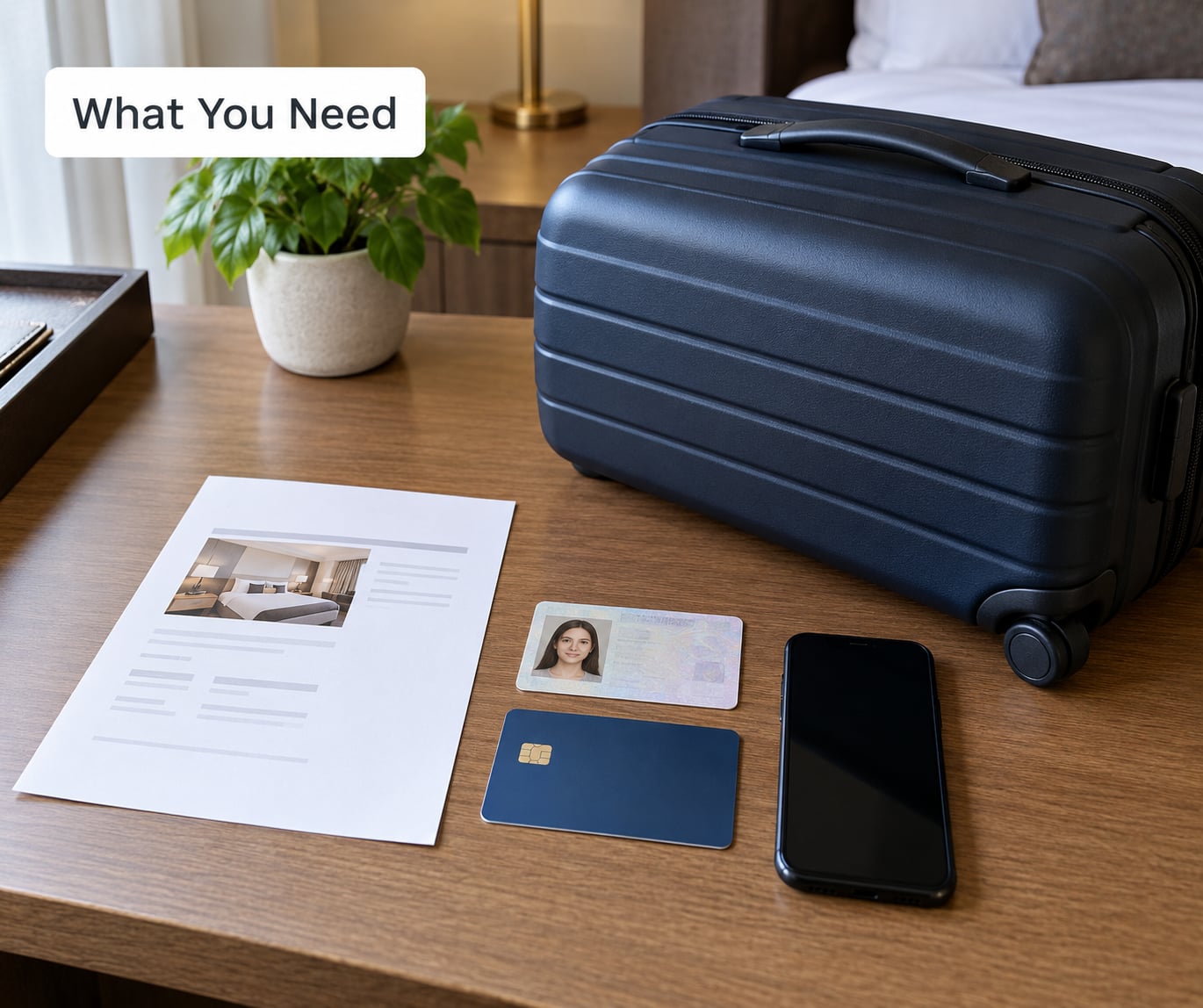
You cannot argue a reservation you cannot show. Have the confirmation in a form that opens without Wi-Fi, on your phone or printed, plus the details below within reach before you walk up to any desk.
- Your confirmation. The confirmation number, the property address and phone number, the dates, the room type and the rate you agreed to. Screenshots of the email and the booking page travel better than a PDF link that needs a login.
- Government-issued photo ID. Required at check-in almost everywhere, and needed again if you are relocated to another property.
- The payment card you booked with. Hotels routinely place an incidental hold, often a few hundred dollars, on a card for incidentals even when you prepaid the whole stay in advance. If the card has a low limit or an expiry date soon after your check-out, tell the desk early and offer a second card.
- The booking terms. Whether the rate was prepaid, prepaid and refundable, or prepaid and non-refundable, and what the cancellation deadline was. That line determines how much leverage you have later.
- Your travel details. Expected arrival time, onward bookings, and a short list of nearby properties you would accept. A named fallback makes the conversation at the desk much faster.
Step-by-Step: How Hotel Overbooking Works and What to Do
Hotels sell inventory they do not have because empty rooms earn nothing, and because on any given night a predictable share of bookings never materialize. The remedy begins once the desk tells you there is no room, and the order you do things in matters more than how firmly you argue.
How hotel overbooking works behind the scenes
Most properties forecast a margin of unclaimed rooms and sell that margin on purpose. On a typical night they expect a slice of bookings to be no-shows, another slice to cancel late on the day, and a few guests to check out early. On high-demand dates, such as a festival weekend, a convention, or a night when every hotel in the city is full, that expected gap can be a meaningful share of the inventory.
Not every oversell is a strategy. Accidental overbooking usually comes from housekeeping or maintenance taking rooms out of service while they are still listed as available, a booking made at the desk or by phone that never reached the central system, a group block adjusted by hand on an extranet, or a channel manager pushing inventory to third-party booking sites out of step with the property’s own system. Add a deliberate oversell on top of any of those and the hotel is genuinely over capacity.
When more guests arrive than there are rooms, the property ranks reservations and relocates the surplus, walking those guests to another hotel. Bookings made direct with the property or through its loyalty program usually rank ahead of third-party bookings, and prepaid guaranteed reservations ahead of flexible rates. The exact ranking is a property decision, not a published standard.
1. Confirm exactly what the hotel has on record
Before reacting, read back the record with the agent. Confirmation number, arrival and departure dates, room type, rate, guest name, deposit taken, and the cancellation terms attached to the booking.
Disagreements here are common and often fixable. A name spelled differently, a date entered as arrival rather than departure, or a booking sitting under a partner agency can make a live reservation look like nothing at all. Success at this step means both of you are looking at the same active reservation with the same conditions attached.
2. Contact the hotel directly and document the request
Call the property’s local number rather than the central reservations line, which may be closed at midnight. Ask for the duty manager or night manager if the desk agent cannot resolve it, and state your confirmation number and arrival time in the first sentence.
Send a written message too, through the hotel’s own channel, and keep it. Forum reports from travelers and front-desk staff keep converging on the same point: a call before a late arrival often changes the outcome, because the manager can pre-assign a room before the night shift takes over. Where you have a written record, you also have proof of what was promised when you later contact the chain or your bank.
3. Ask the hotel to honor the confirmed reservation
Make the case in three sentences. You hold confirmation number X for the night of the date, you have not cancelled, and you are asking them to honor it. Then ask directly whether any room has come free, and request a short hold while cancellations land rather than an open-ended promise to call you later.
You are not obliged to withdraw the booking yourself. Refusing to cancel keeps the reservation live, keeps your claim on the prepaid amount intact, and keeps the hotel responsible for solving the problem rather than for having released it voluntarily.
4. Request a room elsewhere rather than a vague referral
A vague referral is where a lot of trips go wrong. Ask for specifics: the name and address of the property, its star rating and distance from where you needed to be, who is paying, and by when. Ask whether they cover transport to the other hotel, the rate difference if it is more expensive, breakfast or meals, and your first night.
You can name a property yourself. Travelers consistently report that being moved somewhere they chose beats being moved somewhere the hotel picked. If the alternative is materially worse, say so plainly and ask what they will do about it before you agree to anything.
5. Escalate through the booking channel or card issuer if needed
If the property stalls, escalate in the order that matches the type of problem. A booking dispute, meaning the reservation terms themselves, goes to the booking platform or the chain’s customer service line, both of which can see the reservation history. A payment dispute, meaning a charge you do not recognize on your statement, goes to your card issuer as a formal dispute on the transaction.
Consumer protection bodies handle cases where a business has not resolved a complaint, and the rules differ by country, so check what your local authority covers. One caution: never send full card details by email or message. Share the last four digits and the date only, and let the bank handle anything more.
6. Preserve evidence and keep the trip moving
Save everything as you go: the confirmation, every message and call note with dates and times, receipts for the alternative hotel and transport, and any record of what was offered and when. Write a short factual timeline while it is fresh.
Do not let the dispute freeze your travel. Arrange somewhere to sleep the same night, even if it is a basic option, and keep pursuing the resolution the next morning. Travelers who end up with a decent outcome usually did both things at once: they moved fast and they documented carefully.
Common Mistakes
Most problems here come from a few avoidable moves.
- Assuming a non-refundable booking cannot be affected. Non-refundable describes your cancellation, not the hotel’s performance. A prepaid booking that the property cannot honor is still a booking it accepted.
- Waiting until you are standing at the desk. A call on the morning of a late arrival, or the previous evening, frequently resolves it before you travel.
- Refusing to look at a comparable room. Check the terms first, then decide. A sister property with a late checkout may suit you better than a closer downgrade you did not choose.
- Insisting on a specific room that is genuinely unavailable. Asking for an upgrade you would have paid for is fair. Refusing every alternative over a bed type narrows your options for no gain.
- Posting about the hotel before securing a bed for the night. Solve the immediate problem first. Reviews can wait until you have a roof.
- Abandoning the booking channel. The platform holds records you cannot access yourself. Keep it in the loop even if you also contact the chain.
- Forgetting the arrival-time rule of thumb. Front-desk staff widely use a practical version of it: if you plan to arrive after 10 p.m., call, and the hotel will often look for someone else to move first.
Frequently Asked Questions
Can a hotel refuse to honor a prepaid reservation because it is overbooked?
Yes, in practice, and the legal position is weaker than most travelers assume. Unlike airlines, hotels have no government regulator setting overbooking rules, so your protection comes from contract law and industry practice rather than statute. A confirmed reservation is still a commitment the property made. Your refund of the prepaid amount is the realistic outcome. Additional damages on top of that usually require proof of the loss you actually incurred.
What is a hotel walk and how does it work?
A walk is the moment a hotel tells an arriving guest that it has no room for the reservation it confirmed. In practice the desk offers one of three things: a refund, a relocation to another property at the hotel’s expense, or occasionally a room at a sister hotel at a reduced rate. Properties usually rank reservations before they choose, and direct bookings, loyalty members and prepaid guaranteed reservations commonly rank ahead of flexible third-party rates.
Must an overbooked hotel pay for transportation to another hotel?
There is no single rule that applies everywhere, but the common practice is that the hotel walks you, so it moves you. Most properties cover the taxi or shuttle to the alternative hotel and the first night, and many add breakfast. Rules vary by country, property and booking terms, so ask what they will cover before you agree to the move, and keep the receipt for anything you pay yourself.
What is the difference between a prepaid-refundable and prepaid-nonrefundable booking?
Both have the money taken up front, but the terms differ sharply when plans change. A prepaid-refundable rate can usually be cancelled up to a stated deadline with the money returned. A prepaid-nonrefundable rate generally forfeits the payment if you cancel. Neither type removes the hotel’s obligation to deliver the room it confirmed, so an overbooking dispute follows the same escalation path for both, with refundable bookings simply easier to resolve.
Can I get money back if the hotel overbooks my reservation?
Getting your prepaid money back is the most reliably obtainable outcome. Ask for it in writing at the desk before you leave, and if the property does not process it, take it up with the booking platform or the chain’s customer service, both of which can see the reservation record. A card issuer dispute is possible for an unrecognized charge, but it is slower and can cost a relationship with a hotel group you may want to book again.
Conclusion: What to Do First
If it happens tonight, do four things in order. Read back your confirmation details with the agent so you both see the same reservation. Contact the property’s local desk directly and ask for the duty manager, keeping every written reply. Ask for a specific solution, a named nearby hotel with covered transport and a stated rate difference, rather than a vague promise to call later. And document everything as it happens, including receipts and a short timeline.
Do not cancel your own reservation to make the problem smaller, and remember that rules differ by country, by property, by booking channel and by the terms printed on your confirmation. Updated for 2026.