To book flights for a group, start by counting everyone who shares your dates and route, then decide between one airline group reservation and several smaller bookings. Most carriers treat ten or more passengers on the same flight as a group, which unlocks a deposit now and passenger names later. Under ten, you are almost always better off booking directly in batches.
The whole job takes about an hour once the details are gathered, and most of that hour is collecting names that must match travel documents character for character. If anyone is flying internationally, add visa and passport lead time to your timeline, because that is what actually sets the deadline.
I have booked enough of these that the pattern never changes: groups get into trouble at the payment screen, not the search screen. Knowing who is paying, who can be changed, and what happens when one person drops out is worth more than shaving a little off the fare.
Everything below reflects airline group policies as checked in 2026. These rules change often, so confirm thresholds, deposit windows and name cutoffs with the airline before you commit money.
Table of Contents
- 1What You Need
- 2Step-by-Step: How to Book Flights for a Group
- 31. Set the group’s travel dates and airports
- 42. Check airline group and family-booking options
- 53. Search for the best combination of flights
- 64. Confirm passenger details before payment
- 75. Pay together and save the confirmation
- 86. Manage changes, cancellations, and check-in
- 9Common Mistakes
- 10Frequently Asked Questions
- 11How many passengers usually qualify as a group for airline booking?
- 12Can one person pay for several flight reservations at once?
- 13Is it better for a group to book separate tickets or one reservation?
- 14Can airlines hold group fares while everyone confirms?
- 15How should group travelers handle infants, children, or passengers with special assistance needs?
- 16What should I do if one person in the group needs to change their flight?
- 17Conclusion
What You Need
You need two things: a shared trip specification, and one line of accurate data per traveler. Gather both before you open any booking site.
- Exact legal names for every traveler, spelled exactly as they appear in the passport or ID.
- Dates of birth for each traveler, required for nearly every airline form.
- Contact details: an email and phone number that one organizer can actually answer during check-in week.
- Passport details for international travel, including number, issuing country and expiry date.
- Seat and assistance needs: who needs a window seat, extra legroom, wheelchair service, or help for a first-time flyer.
- Baggage requirements, since a checked bag for twenty people is a different cost line from carry-on only.
- One payment method for the whole booking, because most group desks accept a single form of payment for the entire contract.
- Per-traveler flexibility: who can shift a day, who has a fixed event date, and who can drop out without breaking the booking.
Add the date of the event itself, not just the travel dates. A wedding, graduation or match has a fixed time, and that single fact decides whether you need a group contract with name flexibility or just ordinary seats.
If any traveler is an infant, a lap infant, or a minor traveling without an adult, note it now. Airlines price those differently and they change how many seats count toward your group total.
Step-by-Step: How to Book Flights for a Group
The process has six stages, and the order matters more than it looks. Get the dates and passenger count settled first, because everything downstream depends on that number.
1. Set the group’s travel dates and airports
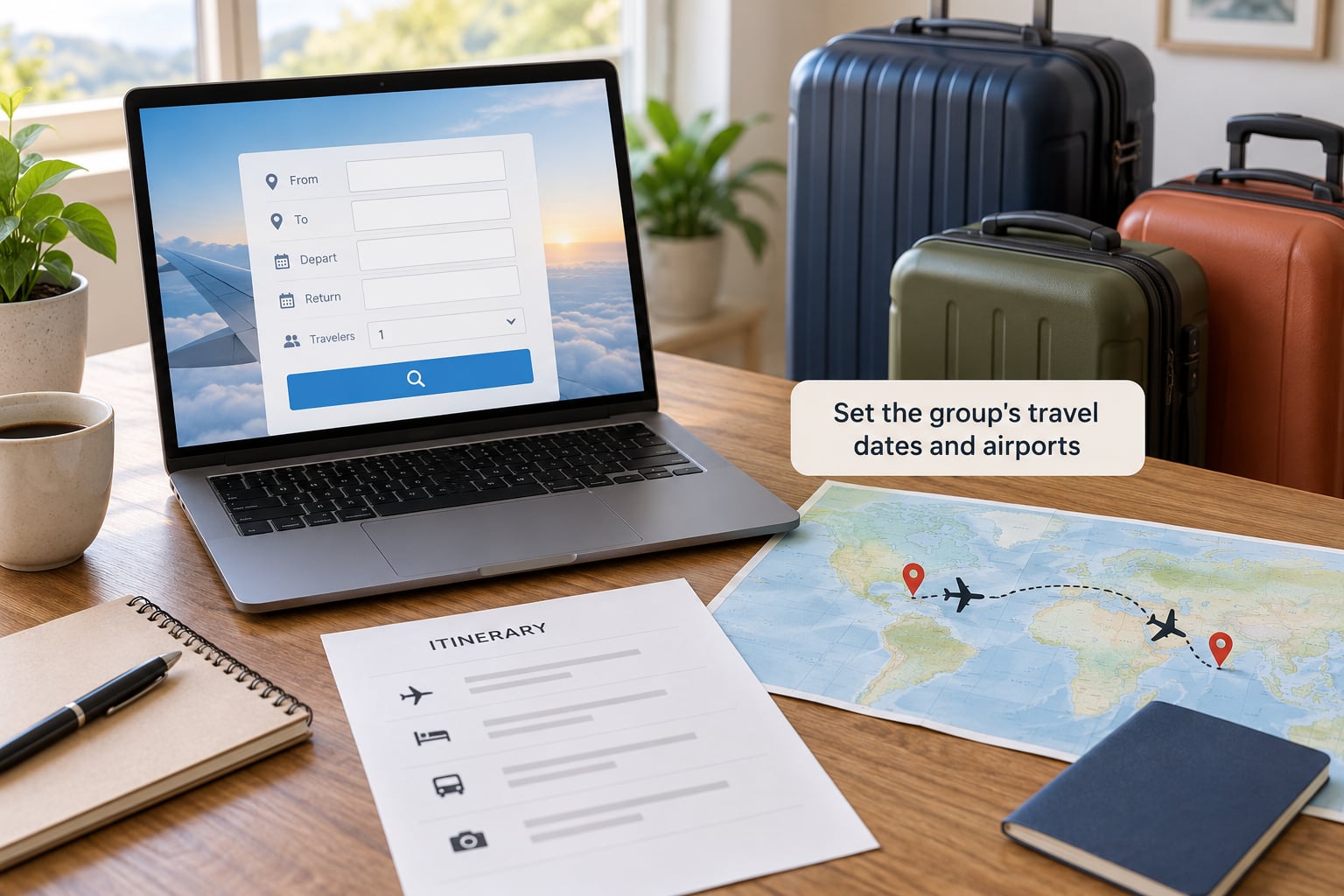
Set the dates everyone can actually travel before you search fares. Write down which dates are fixed by an event and which ones can move by a day, because flexibility is worth real money at the margin and only helps if you know who has it.
Compare nearby airports too. A second airport forty minutes away can open up flights that are sold out at your home airport, and for a large group that difference decides whether everyone travels together.
You will know this step worked when you have one route, one date range, and a confirmed passenger count.
2. Check airline group and family-booking options
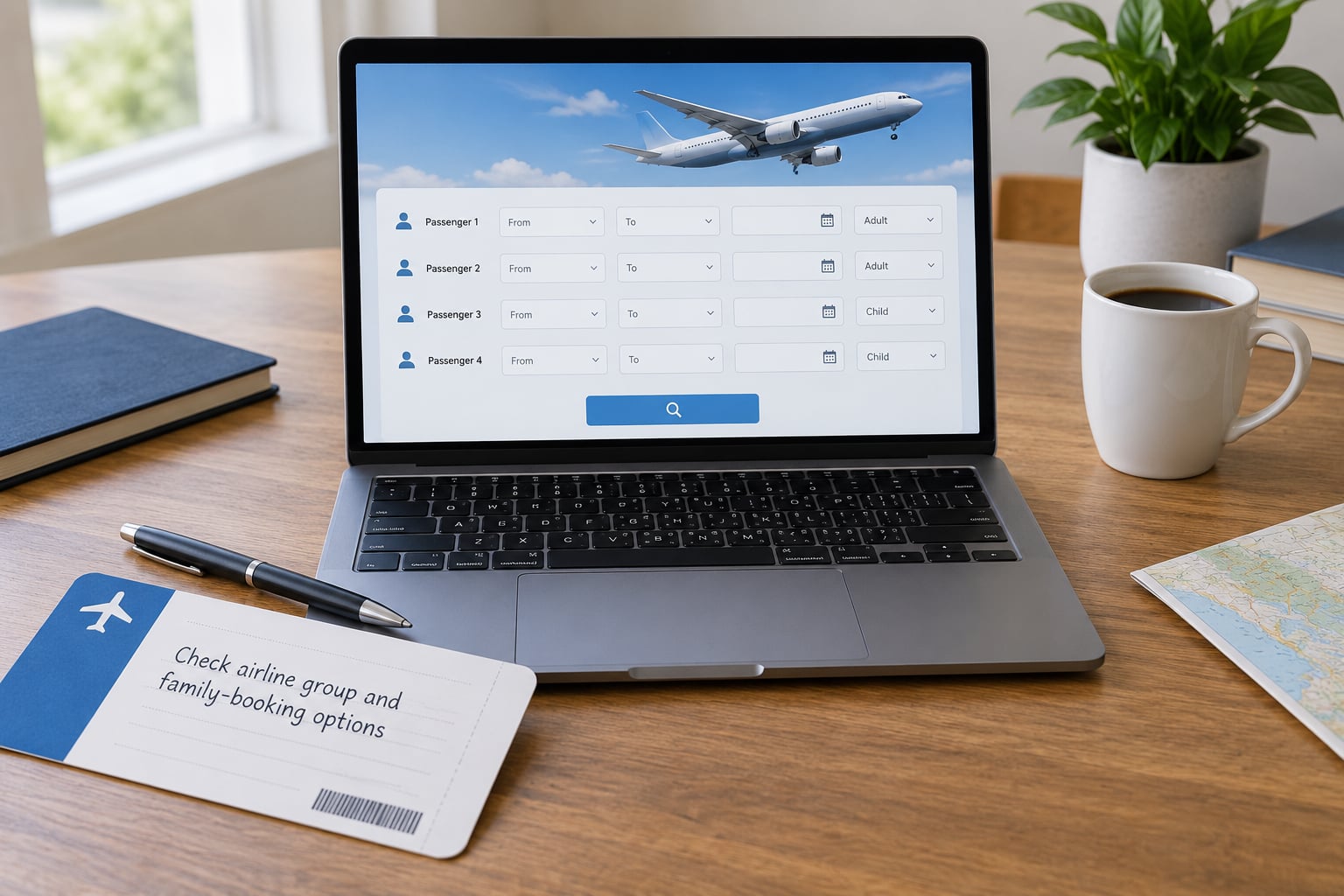
Use the airline group desk or the family booking option when you have ten or more passengers on the same flight. Below that, book it yourself.
Group desks exist because airlines sell large blocks of seats that ordinary websites will not hold. In exchange, they usually want a signed contract, a deposit, and final names by a fixed date, often a few weeks out. Expect the quote itself to take one to three days to come back, which is why you should ask early rather than after you are ready to pay.
Group contracts usually restrict codeshare flights, meaning you may be pushed onto the carrier that actually operates the plane rather than a cheaper partner itinerary. Ask about that before you sign anything.
You will know this step worked when you have a written quote with a price, a deposit amount, and a name collection deadline attached to it.
3. Search for the best combination of flights
Search with your full passenger count in one search rather than piecing the group together afterward. Then read the fare the site shows you carefully, because a group search can quietly move everyone into a higher fare class.
Here is the mechanic behind that jump. Airlines price and release seats by fare class, and a booking engine will usually display a maximum of nine seats in any one class at a given price. Enter ten passengers and the tenth one can trigger a step up into the next class, which lifts the fare for everybody in the search. That is why a search for twenty people sometimes returns a price close to double what a solo search showed.
This is the point where the split-booking debate lives, and people genuinely disagree. One traveler on r/TravelHacks split a Singapore Airlines booking into two separate reservations of two passengers each and reported a clear saving on the second booking. Other threads on the same forum, including a family of ten with toddlers and first-time flyers, leaned toward the airline directly because they needed everyone on one flight and needed help at the airport.
So the honest answer is: split only when the fare difference is large and your group can absorb a split. Otherwise pay the higher group fare and keep everyone in one reservation.
When you compare itineraries, filter by departure times people can realistically make, then check what happens on the far side of a connection. A saving that creates a six-hour layover is not a saving.
4. Confirm passenger details before payment
Collect and verify every traveler record before you enter anything. Once a ticket is issued, name corrections usually mean cancelling and rebuying at whatever the fare is then.
Work through this list for each person: legal name exactly as printed in the passport or ID, date of birth, gender as the airline form requires, contact email, nationality, and passport details if the trip crosses a border. International groups need names to match the passport character for character, including middle names and any diacritics. Keep hyphens and apostrophes exactly as the document shows them.
Capture assistance requests in writing at the same time: wheelchair service, unaccompanied minor handling, travel with a service animal, or extra time at the connection. Adding these later means calling, and the answer is often no.
5. Pay together and save the confirmation
One organizer usually pays for the entire group, and on a group contract that is the only option. Expect a deposit at signing, then the balance on a stated date, often tied to the first passenger name being submitted.
Save three things immediately: the contract or quote PDF, the confirmation email with the group reference, and a screenshot of the itinerary for each person. The group reference is what a group desk agent asks for first when you call about a change, so store it somewhere all organizers can reach.
Share itinerary details through a group thread rather than one person’s inbox, and keep passport numbers out of the shared view. Name, date of birth and contact details are all that fellow travelers need to run their own check-in.
6. Manage changes, cancellations, and check-in
Read the fare rules on every ticket in the group before you celebrate. A contract that allows free name changes until ticketing becomes a standard ticket with fixed names the minute it is issued, and that difference decides how much trouble a dropout causes.
For changes, route everything through the organizer who holds the booking. Airlines will not let one passenger in a group PNR alter a segment without affecting the others, so a local change often means the whole record gets reopened.
If someone drops out, you have three options depending on timing: cancel for a refund where the fare allows it, transfer the seat with a name change if the contract still permits it, or leave the ticket in the group and accept the loss. Name changes before the ticketing deadline are the cheapest outcome, which is the whole reason people use group contracts for events with uncertain attendee lists.
One refund rule catches nearly every group organizer out. Refunds go back to the original form of payment, so if one person paid for six tickets and two travelers cancel, the money returns to that person’s card, not to the travelers who cancelled. Agree in advance how a refund gets passed back.
Check-in opens per passenger, usually online a day before departure for most airlines. Have each traveler’s document details ready, because support lines are slow on group travel days.
Common Mistakes
The expensive errors in group flight booking are almost all clerical, and every one of them has a simple fix.
Typing names from memory or from a nickname. Use the passport or ID, character for character. A middle name missing or a shortened surname can cost a full fare difference to fix, or the ticket outright.
Buying separate itineraries with no connection plan. Independent tickets carry no protection. If one flight is delayed, the airline will not move the other booking, and your group gets separated. Separate bookings work when everyone travels the same day on the same flight; they fail badly across multi-city legs.
Ignoring baggage rules until the airport. Group fares sometimes restrict checked bags or charge per piece. Twenty checked bags sorted into the wrong cart at the counter is a long line and an expensive overshoot.
Waiting too long to pay a held quote. Group quotes and held seats expire. If the contract lapses you restart the process days later, usually at a different price.
Assuming every ticket in the group has identical flexibility. Mixed fare types are normal when someone joined late or upgraded. Pull up the rules per ticket, not per booking, before you promise anyone a change.
Chasing the lowest fare instead of the same flight. Travelers on r/TravelHacks kept returning to the same priority: being on the same flight with the same people matters more than a small fare difference. Decide that priority explicitly before you start comparing.
Booking without a named organizer. Groups drift when nobody owns the booking. One person, one confirmation record, one point of contact with the airline.
Frequently Asked Questions
How many passengers usually qualify as a group for airline booking?
Most airlines set the threshold at ten passengers traveling on the same flight on the same itinerary. Some carriers handle parties of seven to nine through a family or large-party desk instead, and a few handle smaller numbers online with a capped passenger count per booking. Below ten, book it yourself in batches of two to four, since a single large search tends to push everyone into a higher fare class.
Can one person pay for several flight reservations at once?
Usually yes, and it is the normal setup. One card or account pays for the whole group, which also means one person receives every refund. On a group contract, a single form of payment for the entire booking is usually a requirement rather than a convenience. If you need travelers to pay their own way, book separate reservations of a few passengers each and stagger the bookings so the fare classes do not all jump at once.
Is it better for a group to book separate tickets or one reservation?
One reservation wins when everyone must travel together, since a single record means coordinated seating, coordinated rebooking during disruptions, and one place to call. Separate tickets in small batches can cost noticeably less because each booking stays under the fare-class ceiling airlines apply to large searches. The tradeoff is real: separate tickets carry no protection from each other, so a delay in one booking will not move the others.
Can airlines hold group fares while everyone confirms?
That is the main reason to use a group desk. A group quote holds a block of seats at a set fare while you collect names, and many contracts allow free name changes until the ticketing deadline, which can be weeks before departure. Quotes usually take one to three days to come back and expire on a stated date. Below ten passengers you should not expect this flexibility from a standard website booking.
How should group travelers handle infants, children, or passengers with special assistance needs?
Flag every one of these when you first contact the airline, not at check-in. Lap infants have their own fare and seating rules, minors traveling alone need unaccompanied minor service booked in advance, and wheelchair or mobility assistance usually requires a request 48 hours ahead. Travelers with these needs should be placed on the same flight as the adult responsible for them, which often means booking those passengers first and building the rest of the group around them.
What should I do if one person in the group needs to change their flight?
Go through the organizer who holds the booking rather than having the traveler call themselves. Before the ticketing deadline, a name change is often free under a group contract and is the cheapest fix. After ticketing, options narrow to cancelling for a refund if the fare allows it, paying a change fee, or leaving the ticket as a loss. Refunds return to the original form of payment, so the person who paid is credited, not the traveler who cancelled.
Conclusion
Start by confirming the dates, airports and final passenger count, because that number decides your entire booking method. Compare the airline group desk against buying in small batches, then verify every passenger name against their travel documents before payment. Last, read the change and cancellation rules on each ticket so you know who can be replaced and where a refund would land.