Airfare prices change so often because airlines never hold one fixed price for a seat. A revenue management system repricing the same flight repeatedly, reacting to how fast seats sell, how many cheap ones are left, what rivals charge and how close departure is. One design decision, and most of the swings travelers notice follow from it.
The short answer: the price you see is a live reading of a flight, not a property of it. Change the conditions — the date, the departure time, how many cheap seats remain — and the reading changes with them.
Table of Contents
- 1What Makes Airfare Prices Change During the Year?
- 2How Airline Pricing Systems Set Fares
- 3How Do Demand and Remaining Seats Affect Prices?
- 4Why Does the Price Change When I Look Again?
- 5Why Airfare Prices Change So Often for the Same Route
- 6How Often Should You Check a Flight Price?
- 7What Can Travelers Do When Fares Keep Changing?
- 8Frequently Asked Questions
- 9Is it normal for airline ticket prices to change within minutes?
- 10Does airline dynamic pricing mean every traveler pays a different fare?
- 11Why can a ticket price go down after you search for a flight?
- 12Do airlines change prices differently for each route and flight time?
- 13Can I stop an airline from changing the fare after I search?
- 14Conclusion
What Makes Airfare Prices Change During the Year?
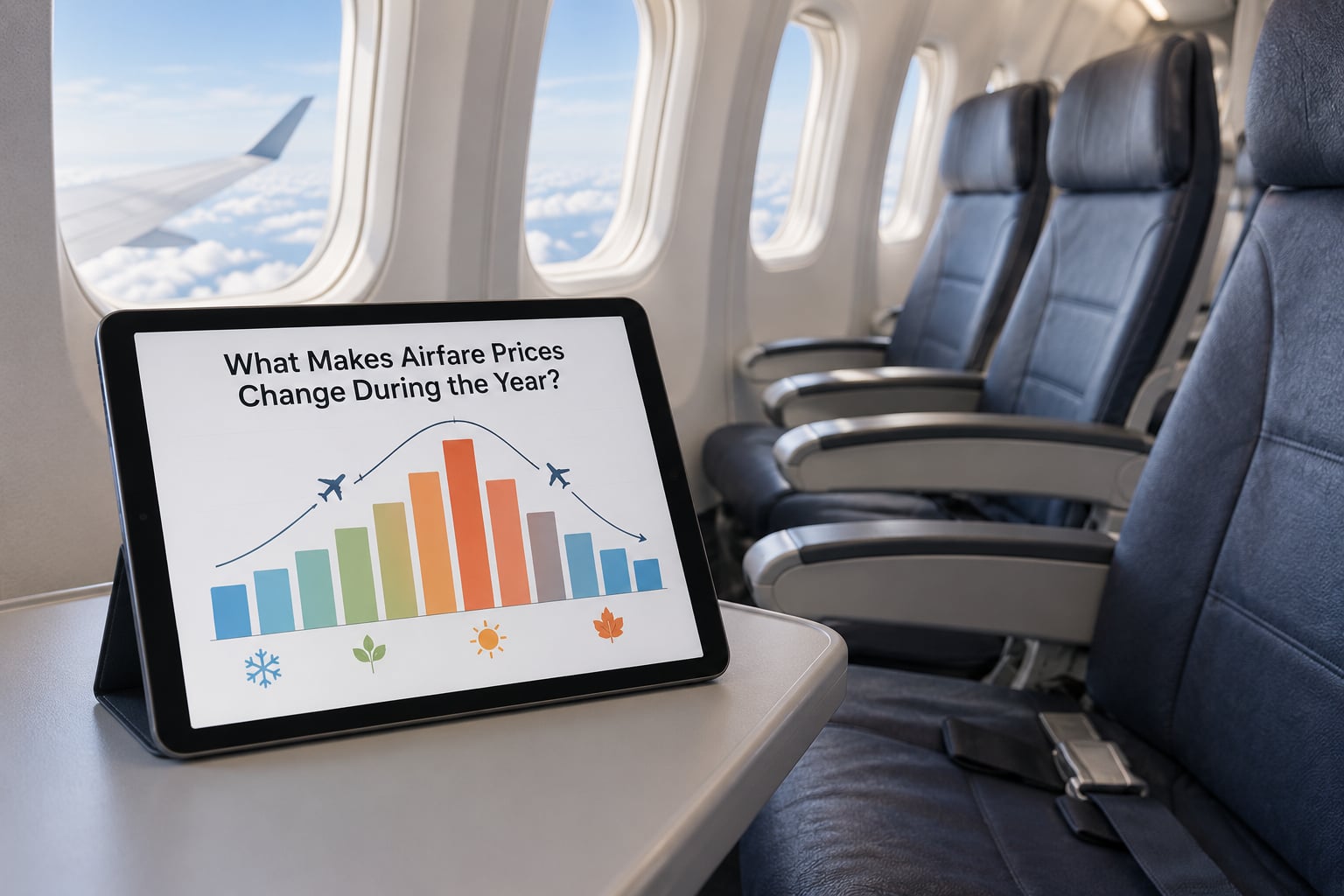
Six forces do most of the moving. They rarely act alone, which is why a fare can climb on a Tuesday and fall on the Wednesday of the same week on the same route.
- How fast the flight is selling. Airlines track the booking pace against the forecast for that flight. Sell ahead of the curve and the cheap inventory closes early; sell behind it and prices soften or seats are released back at a lower fare.
- How many cheap seats are left. Each flight carries a limited number of seats at the lowest fare. When those go, the next price level opens automatically for everyone still looking.
- How close departure is. Time is the strongest single input. Fares typically step upward as departure nears and cheap inventory thins, though a slow-selling flight can break that pattern and drop.
- Seasonality and calendar events. School holidays, the festive period, citywide conventions and major sporting events all concentrate demand on specific dates and airports.
- What competing airlines charge. On a route with several carriers, pricing systems watch rival fares closely and adjust to stay in the same band, or undercut it deliberately for a short window.
- Costs outside the airline’s control. Fuel, airport charges, crew shortages and a cancelled aircraft rotation all feed into fare decisions without warning.
Two kinds of pricing driver are worth separating, because they behave differently. Inventory-driven moves happen when seats in a price band run out.
| Driver | What it is | Typical effect on the fare |
|---|---|---|
| Demand | How many people want the flight, and how urgently | Rises when a flight fills early or sells out |
| Seat capacity | Seats assigned to each fare level on the aircraft | Falls as cheap inventory sells out |
| Seasonality | Regular peaks such as holidays and weekends | Predictable premiums on peak dates |
| Fuel and airport costs | Operating costs feeding surcharge adjustments | Slow upward pressure on base fares |
| Competition | Fares offered by other carriers on the same route | Pulls the fare up or down in bands |
| Distribution costs | What a site or agent charges to sell the seat | Makes the total differ from the airline’s own fare |
Demand-driven moves happen when a whole flight, not one price band, becomes hard to sell or hard to avoid.
How Airline Pricing Systems Set Fares
Airlines set fares twice: once when a flight goes on sale, and continuously afterwards. The first decision happens months ahead, when the route is loaded into the revenue management system with a ladder of fares built from historical booking data on that aircraft and that market.
That opening ladder is not one price per seat. Every flight carries several fare classes at once, each with its own price and its own rules about changes, refunds and how early you must book. What you see on a search is the cheapest class that still has an available seat in your cabin.
Everything after that is adjustment. When a fare class sells out, the next one up opens. When a class sells too slowly, the airline can add seats to it, discount it or withdraw it. The system does not wait for a human decision on any single seat sale.
A few terms come up constantly in conversations about this, and they are worth having straight:
- Fare bucket: the group of seats at one price level on a flight, held in the inventory system.
- Fare class: the code attached to a booking that decides its rules, separate from the cabin you sit in.
- Fare family: the branded group of classes sold together, such as a basic or main cabin product, each with its own included extras.
- Load factor: the share of seats actually filled on a flight. High load factors leave little reason to discount.
- Booking curve: the expected shape of bookings over time for one flight, from the day it opens for sale to departure.
- Advance purchase requirement: the rule that a fare must be bought a minimum number of days before departure to qualify.
- Price elasticity: how much demand moves when the price moves. Leisure demand is elastic, business demand far less so, and the pricing system prices that difference in.
How Do Demand and Remaining Seats Affect Prices?
Booking pace is the number the system watches most closely. Every few minutes it compares actual bookings on your flight with the forecast, then decides whether the flight is ahead of plan or behind it. Ahead means close the cheap classes. Behind means find a reason to sell, because an empty seat earns nothing today and almost nothing tomorrow.
Take a route between two business centres that also serves a lot of weekend leisure traffic. On a Friday evening, the flights are dominated by people who must travel on specific days. Demand is stiff, booking runs early, and the low fare classes can close weeks ahead of departure.
On the Tuesday morning return of that same route, the same aircraft has a different demand profile. Leisure travellers are flexible, so a higher fare suppresses volume more sharply. The pricing system reads that, and fares on that flight tend to sit lower for longer and move later.
Departure time matters for a separate reason: a red-eye uses an aircraft for the next morning, so it fills two days of demand with one seat sale. That makes its inventory scarce in a way a midday flight’s is not, and the fare reflects it.
Holidays work on the same logic but with a wider blast radius. A city hosting a major event can see fares across several nearby airports climb at once, including on routes with no direct connection to the event itself, because travellers rebook onto whatever gets them there.
Why Does the Price Change When I Look Again?
Because the reading is live and your second visit is a new reading. Several things are happening at once.
- Inventory refreshes. The fare classes open and close throughout the day as seats sell and as the system adjusts its forecast.
- Fare class availability changed. The bucket you were seeing may have sold out, or may have been closed by the airline, leaving a different price as the new floor.
- Cache delays. Booking sites and airline sites hold their own copies of the fare file. One may simply be showing you data that is minutes or hours behind the live inventory.
- Route-specific pricing. The same flight number on a different day is a different product with a different forecast, so it reprices on its own schedule.
- The original fare is gone. Nothing is reserved when you look. Once a bucket is empty, the price you liked is not recoverable, and the site has no obligation to keep showing it.
Why Airfare Prices Change So Often for the Same Route
Each flight is priced independently, even when the route looks like a single product. A carrier repricing Tuesday morning at 6am is reasoning about Tuesday morning’s forecast, not the week’s average, so two identical-looking itineraries on the same route can sit at very different levels at the same moment.
There is a second reason fares for the same route look inconsistent. Airlines adjust their own base fare and their separate charges, such as baggage or seat selection, at different times and by different rules. A higher headline fare on one itinerary can still produce a lower total once both are checked at the checkout screen, which is the only comparison that counts.
How Often Should You Check a Flight Price?
More often than feels productive. Refreshing a search every twenty minutes tells you very little, because meaningful movement happens when inventory changes or when the system re-forecasts, not on a schedule you can time.
Price alerts are more useful than refreshing. Set one on your route and dates, and let the tools do the watching. Google Flights shows a price history graph for many routes, which at least tells you whether what you are looking at is unusually high, ordinary or already at the floor for that market.
The decision framework is simpler than most advice suggests:
- Book now when your dates are fixed, the fare is comfortably below what the price history shows as normal, or the flight is one you would not find an alternative to.
- Keep watching when your dates are flexible, the flight is not selling ahead of its curve, and there is a comparable option nearby.
- Stop watching when you are inside the final fortnight on a peak route. Cheap inventory on those flights is usually already gone.
One detail worth knowing: airline call centres and agents can sometimes honour a fare that has just moved. A poster in r/unitedairlines reported United restoring an original price after a phone call, and an r/americanairlines poster was quoted a higher fare ten minutes after checking in, with the agent attributing it to dynamic pricing and urging an immediate purchase. Neither outcome is guaranteed, but a quick call is cheap to try.
What Can Travelers Do When Fares Keep Changing?
You cannot slow the pricing system down. You can change the inputs it reacts to, or make sure the price you accept is the price you actually pay.
- Move the date, not just the time. Shifting a trip by one day on a Friday-heavy route often changes more than shifting the departure hour.
- Check nearby airports. A secondary airport an hour away can carry a fare the hub cannot, once transport is counted.
- Look at the return leg on its own. Round trips priced as a bundle can hide a cheap outbound paired with an expensive return.
- Compare the total, not the fare. Bags, seat choice and changeability are part of what you are buying, and they vary between fare families on the same aircraft.
- Read the fare rules before you pay. A restrictive fare that cannot be changed is a poor deal if your plans are not firm.
- Set an alert and stop refreshing. Monitoring works; refreshing mostly adds noise.
- Check whether the route is competitive. Routes with several carriers reprice more often and usually have more floor underneath the price.
Booking windows give a rough shape to how fares behave on different kinds of trip. These are typical patterns, not guarantees:
| Days before departure | What usually happens |
|---|---|
| 120 days and beyond | Limited inventory opens on some routes, often at the higher end of the ladder |
| 60 to 90 days | More fare classes open; competitive routes often show their lowest typical fares |
| 21 to 45 days | Domestic fares commonly sit near their low point, then begin climbing |
| 7 to 21 days | Cheap buckets on good flights are typically thinning |
| Under 7 days | Mostly the last seats in mid-range and high classes, except on slow-selling flights |
It is worth settling the search-history argument plainly, because travel sites still contradict each other on it. Users on airline subreddits frequently believe their own repeated searching caused an increase, and airlines deny repricing per individual search. Both observations can be true at once: the fare moved because seats sold and the clock moved, and you happened to be watching when it did.
| Claim | Verdict |
|---|---|
| Searching repeatedly raises my fare | No reliable evidence airlines reprice per individual search. The move comes from inventory and time passing. |
| Incognito mode reveals cheaper fares | No consistent evidence for it on airline sites. Prices differ by device mostly because of cached fare files. |
| A VPN unlocks another region’s price | Fare files are broadly the same by region, and what changes most often is the currency you see. |
| Searching at 2am or 3am is cheaper | Unsupported. Clock hour has no reliable relationship to fare; days until departure does. |
| A fare is locked once I see it | No. Nothing is held until the booking completes. |
Award travel moves the same way as paid fares, which surprises people who assume miles pricing is fixed. A r/unitedairlines poster reported an award price rising by ten thousand miles within four minutes of searching.
Frequently Asked Questions
Is it normal for airline ticket prices to change within minutes?
Yes, on a busy route this is ordinary. Pricing systems update inventory continuously, so a fare class can open or close between one search and the next, sometimes inside a single refresh. On quieter routes with one or two carriers, changes are usually daily rather than constant. A sharp jump usually means a cheap bucket sold out, not that anything about your search caused it.
Does airline dynamic pricing mean every traveler pays a different fare?
Usually not, at least not for two people on the same booking. Most fares are set at a class level and everyone in a cabin buying that class pays the same amount. Individual differences come from fare families, codes entered at checkout, corporate or member agreements, and third-party sites adding their own margin. The variation people notice is usually between fare classes rather than between individual seats.
Why can a ticket price go down after you search for a flight?
A fare falls when the system decides it needs to sell seats more urgently, which happens on flights selling behind their forecast or close to departure with empty rows. It can also drop when a rival undercuts a fare, or when a carrier reopens a class it had closed. Prices can and do fall without warning, but there is no reliable way to predict which flight will drop, so a falling fare is a reason to book rather than a signal to wait.
Do airlines change prices differently for each route and flight time?
Yes, because each flight is forecast and repriced on its own. A Friday evening flight carrying mostly business demand is treated very differently from a Tuesday morning flight with flexible leisure travellers, even on the same route with the same aircraft type. Competition also differs: routes with several carriers move more often and usually hold a lower floor than routes with one or two.
Can I stop an airline from changing the fare after I search?
No, not through searching. Nothing reserves a price until a booking completes, and no browsing setting holds a fare open. What you can do is book as soon as a fare is genuinely good for your dates, or ask a call centre to honour a price that has just moved, which some carriers will do and others will not. Why airfare prices change so often is precisely because they are a live reading rather than a held quote.
Conclusion
Airfare is a live reading, not a fixed price with a sale attached. Demand, remaining seats in each fare bucket and the time left before departure are the three inputs worth watching, because they drive most of what you see.
Do one thing now: set a price alert on the route you actually want, check the price history on it once, and decide your threshold. After that, stop refreshing.