An open jaw ticket is a single airline booking where you fly into one city and fly home from a different one. Both flights sit on the same ticket, and the stretch between your arrival city and your departure city is deliberately left unbooked so you can cover it by train, bus, car or a cheap budget flight. It removes the backtrack and usually costs about the same as a normal round trip.
That last point surprises people. On the Rick Steves community forum, the question arrives almost word for word every time: what is an open jaw ticket? The term sounds like jargon, but the concept is simple once you see the route shape. If your trip naturally begins in one place and ends in another, you can fly both ends of it without flying back to where you started.
Below is what the structure actually looks like, what it costs relative to the alternatives, and how to build one on an airline site or a booking platform without tripping over the rules.
Table of Contents
- 1What Is an Open Jaw Ticket?
- 2What Is an Open Jaw Ticket in Practice?
- 3How Does an Open Jaw Ticket Work?
- 4Open Jaw Ticket vs. Round-Trip Ticket
- 5Open Jaw Ticket Examples
- 6How to Book an Open Jaw Ticket
- 7When Is an Open Jaw Ticket Worth It?
- 8Open Jaw Ticket Prices and Fare Rules
- 9Common Problems When Booking an Open Jaw Ticket
- 10Frequently Asked Questions
- 11Are open jaw tickets more expensive?
- 12Which airlines allow open jaw tickets?
- 13Can you give me an example of an open jaw flight?
- 14What is the difference between an open jaw ticket and a multi-city booking?
- 15Do I need a separate ticket for the gap segment?
- 16How to Book an Open Jaw Ticket with Confidence
What Is an Open Jaw Ticket?
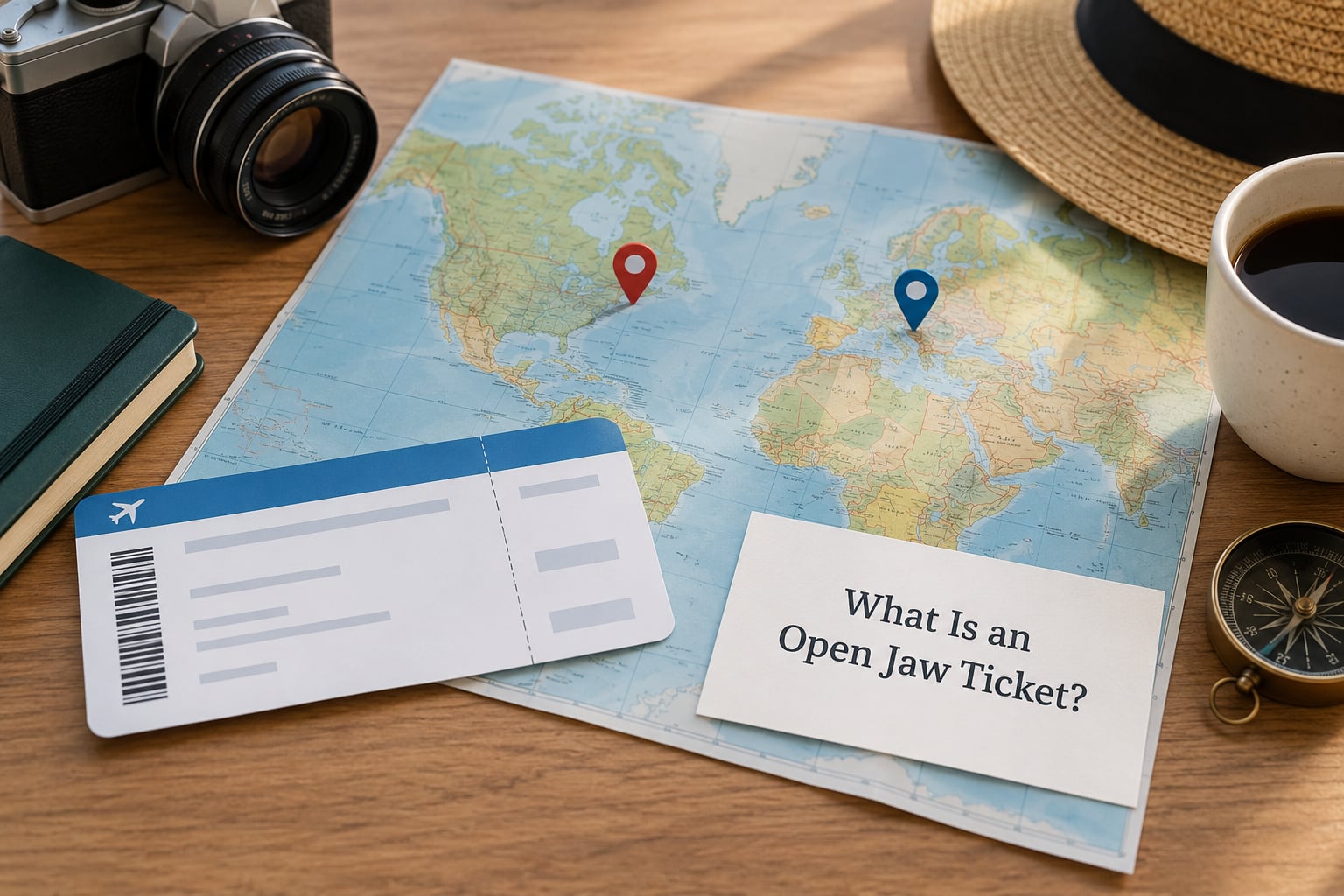
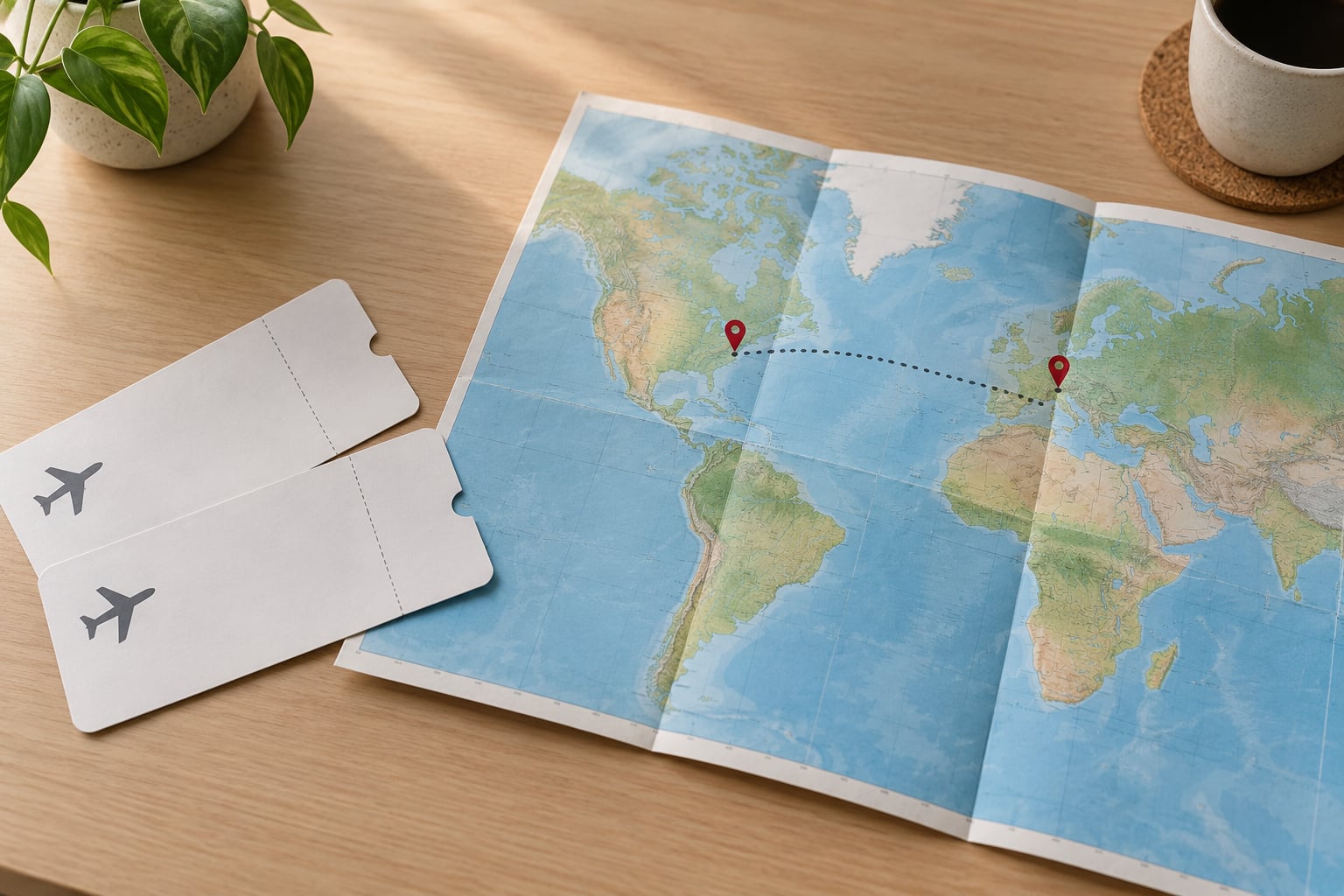
Written in route shorthand, an open jaw ticket is A → B on the way out and C → A on the way back, where B and C are different cities. A normal round trip is A → B → A, with the same city at both ends. Change the closing city and the ticket becomes open jaw.
What Is an Open Jaw Ticket in Practice?
Say you land in Madrid, spend two weeks travelling by train through Spain and France, and fly home from Paris. A round trip forces you back to Madrid to catch the flight out, which can mean an extra half day on a train or an expensive domestic hop. An open jaw ticket covers Madrid in, Paris out, and the whole Iberian rail loop sits neatly in the unbooked gap.
The two endpoints do not have to be in the same country, and they do not have to be in the same continent. What matters is that the booking starts and finishes at the same place while the middle of the trip happens somewhere else.
One practical limit: most airlines do not treat two airports in the same city as a true open jaw. Flying into New York JFK and out of LaGuardia is usually sold as a normal itinerary with two airports in one city, and some carriers price it as a round trip to the same metro area. If that shortcut is what you need, check the fare rules for your specific route rather than assuming the open jaw discount applies.
How Does an Open Jaw Ticket Work?
A working open jaw has three parts, and only two of them are on the ticket.
The outbound segment runs from your home airport to your arrival city. The return segment runs from your departure city back to your home airport. Between them sits the gap segment, the part of the journey you arrange yourself.
Because the two flights share one reservation code, the airline treats them as one routing when it prices them. It builds the fare from both directions rather than quoting you a one-way price plus a second one-way price, which is why the total often lands close to a standard round trip. The result is a single ticket number, one set of check-in rules, and one place to call when something goes wrong.
That through-protection is the part people miss. If your inbound flight is delayed three hours and you have a connection booked the same day, the airline moves the connection. If the two flights were separate tickets, you are on your own.
Open Jaw Ticket vs. Round-Trip Ticket
The practical difference comes down to route shape, the middle of your trip, and what happens when something breaks. Multi-city and two one-way tickets sit alongside them in most booking engines, so it is worth seeing all four side by side.
| Ticket type | Route pattern | Middle of trip | Airline protection | Best for |
|---|---|---|---|---|
| Open jaw | A → B in, C → A out | You cover the B-to-C gap yourself | Full, both flights on one ticket | Trips that end somewhere other than they began |
| Round trip | A → B → A | You stay in B and return to it | Full | Single-base trips with one destination |
| Multi-city | A → B → C → A, all booked | The airline flies every leg | Full | Three or four cities with no overland leg |
| Two one-way tickets | A → B and C → A, separate | You cover the B-to-C gap yourself | None across the gap | Routings where the two directions are priced very differently |
The open jaw and the multi-city booking are often confused. They are not different products. A multi-city itinerary that leaves one leg empty is an open jaw; a multi-city itinerary with every leg filled in is just a multi-city. The booking screen is usually the same one.
Two one-way tickets produce a route identical to an open jaw, with one large difference: nothing links them. If the second flight is cancelled, the airline will not put you on the next one. If a rail strike delays your arrival in the departure city, that ticket is your problem, not theirs.
Open Jaw Ticket Examples
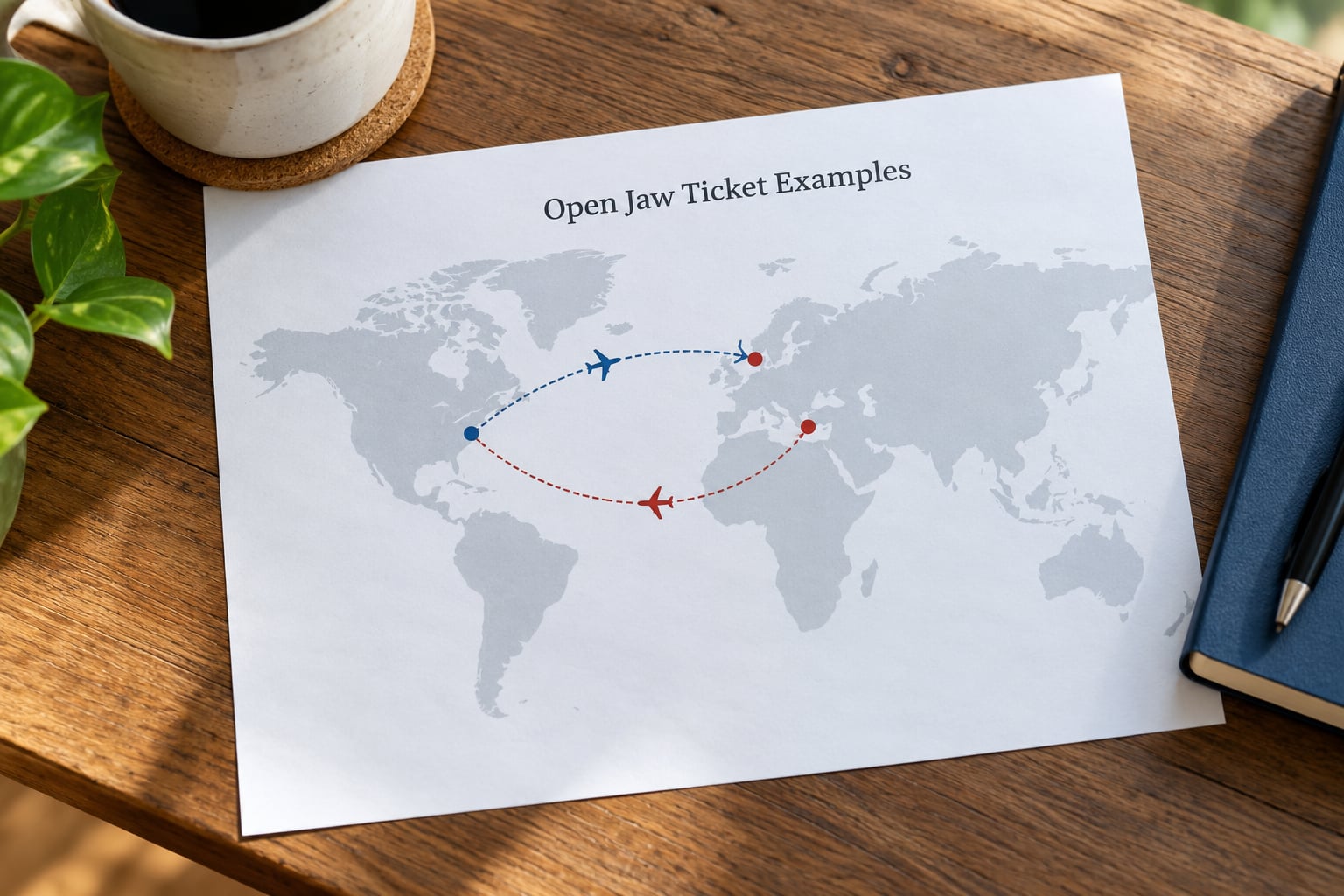
One-way international with a return home. You fly from New York to Tokyo, spend three weeks there, and fly Tokyo back to New York. That is a standard round trip, and no open jaw is needed. The structure earns its keep when the outbound and return are on opposite sides of the world from your home base, such as arriving in Barcelona and returning from Athens after a two-country trip.
Europe multi-city by rail. Land in Rome, travel by train through Florence and Venice, then fly out of Amsterdam. The open jaw covers Rome in and Amsterdam out, and the rail leg is the gap. FlyerTalk regulars apply a simple break-even test here: if the standalone train or budget flight between the two gap cities costs more than the round-trip fare you would have paid otherwise, the open jaw has not saved you anything.
Domestic road trip with a regional return. Fly into a major hub, drive the coast for a week, and return from a smaller regional airport closer to home. Users on r/unitedairlines describe exactly this pattern, pricing the open jaw through the multi-city tool and buying a cheap domestic one-way to bridge the gap when the two ends are too far apart to drive.
Cruise with different ports. You embark in one port and disembark in another, which is a ready-made open jaw. Fly to the embarkation city, cruise, then fly home from the disembarkation city. r/cheapflights users book these routings through multi-city search, sometimes in business class, because the cruise line has already moved the traveller between the two ports.
How to Book an Open Jaw Ticket
- Write down the true first and last city. Not the city you wish you were in. The arrival city and the departure city are the whole structure, and everything else is negotiable.
- Open the multi-city option. On airline sites and on Expedia, Priceline, Travelocity and Google Flights it is usually labelled multiple destinations, multi-city or multi-destination. It is often hidden behind a link on mobile, which is the single most common reason people think the option does not exist.
- Enter only two segments. Home to arrival, then departure city back home. Leave the middle leg blank. Resist filling it in, because adding a third flight turns the itinerary into a booked multi-city and can push the price up sharply.
- Compare the total against the alternatives. Put the open jaw total next to a round trip to the arrival city and next to two separate one-ways. Include baggage in both comparisons, because a basic economy fare with no checked bag is not a like-for-like price.
- Read the fare rules before paying. Check change and cancellation terms, the baggage allowance on each segment, and whether the fare allows a stopover on the long-haul leg.
- Confirm the gap segment yourself. Line up the connection, the entry requirements for the gap country, and enough buffer time. If the middle leg is a flight on a different airline, treat it as a separate booking and build in hours, not minutes.
When Is an Open Jaw Ticket Worth It?
It is worth it when your trip already has an open shape. Travelling forward instead of back and forth, ending near home rather than at the arrival airport, or following a cruise, rail or road route that moves you across a region all fit the structure naturally.
The decision rule people use on travel forums is arithmetic. Price the open jaw as one ticket. Then price the gap segment on its own. If the standalone gap cost is higher than the difference between the open jaw and a plain round trip, book the open jaw. If the gap is cheap, buy it separately and you keep the flexibility.
It is not worth it for a single-base trip. If you are spending the whole week in one city and returning to the same airport, you gain nothing. It is also rarely worth it when the two endpoints are airports in the same metro area, where airlines frequently price the same as a round trip. And a long-haul outbound paired with a short regional hop on the same full-service carrier can cost more than two one-ways, which is the price jump travellers on r/Flights describe.
Open Jaw Ticket Prices and Fare Rules
There is no fixed price for an open jaw ticket, and any figure you see quoted in a guide will be out of date before you book. Airlines change fares daily by route, season and demand, and the structure itself carries no premium. What you pay depends on your dates, the two cities, the carrier and cabin you choose, how much lead time you have, and whether the fare includes checked baggage or seat selection.
The mechanism is worth understanding. Because an open jaw is priced as a single routing, airlines generally build the fare by averaging the two one-way directions rather than quoting each side independently. That is why so many travellers find an open jaw priced at or near the same amount as a round trip to the arrival city. When the two directions happen to be priced very differently, the open jaw can land on the expensive side of that average.
Budget carriers sit outside this logic. Their one-way fares are frequently cheaper than a full-service round trip, so an open jaw built on two budget flights can cost more than two separate bookings. Low-cost carriers also sell their own bags and seats, and on some of them the fare for two sectors exceeds what you would pay on a single sector with an add-on.
Award bookings follow their own rules, and that is where the confusion starts. Loyalty engines frequently reject an open jaw search outright with a not a valid flight message, and multi-city international searches sometimes return only basic economy fares with no points and no free bag. If the search fails, book each segment separately in the loyalty program and pay the small segment fee. Miles and status are still earned on both segments, because they are two ordinary priced itineraries. Round-the-world fares on major alliances are another route to the same outcome, since they allow multiple stopovers on one ticket.
Common Problems When Booking an Open Jaw Ticket
The price jumps when you open multi-city. Adding a third or fourth city switches the itinerary out of a two-segment fare bucket and into a much more expensive one. Stick to two segments and the gap stays yours to arrange.
The gap is treated as a connection. If the airline thinks your unbooked middle leg is a missed connection, a delay there can invalidate the rest of the trip. Build a buffer of several hours between arriving in the gap city and the departure flight, and treat that middle leg as a separate booking no matter how short the distance.
Baggage and entry rules on the open segment. The unbooked leg has no airline attached to it, so you re-pack, re-check and clear customs on your own. You also need whatever entry documentation the gap country requires, and if you cross a Schengen border by land you pass a border control rather than an airport immigration desk. Know the rules for both countries before you commit.
Unused tickets. Buying a round trip and using only the outbound half usually forfeits the return, and the credit is rarely refundable. If you might skip the return, price it as a one-way from the start.
Skiplagging is not this. Buying a cheap ticket to a further city and getting off early, known as hidden city ticketing, is a different tactic with different rules. Carriers detect it and cancel the reservation, which strands you. A properly ticketed open jaw leaves nothing to be caught doing.
Assuming the airline will rebook you across the gap. It will not. Through-protection covers the segments on your ticket and stops at the end of each one.
Frequently Asked Questions
Are open jaw tickets more expensive?
Usually not. Airlines price an open jaw as one routing, generally by averaging the two one-way directions, so the total often matches a round trip to your arrival city. It can cost more when the two directions are priced very differently, when you pair a long haul with a short regional hop, or when budget carriers and separate bags are involved. Compare the full total, including baggage, against two one-ways before deciding.
Which airlines allow open jaw tickets?
Most full-service carriers sell them through the multi-city option on their own site, including the large US airlines and the major European and Asian networks. Alliances such as Oneworld and Star Alliance handle them the same way, and round-the-world fares can cover the same ground with stopovers. Low-cost carriers like easyJet, Ryanair and AirAsia can be used on the ticketed segments, though their fares rarely work out cheaper. Always confirm the rules on the carrier site at booking.
Can you give me an example of an open jaw flight?
Fly from New York into Rome, travel by train through Florence and Venice, then fly home from Paris. The ticket covers New York to Rome and Paris to New York, while the rail journey between Rome and Paris is the part you arrange yourself. Both flights sit on one ticket number. The same logic works across countries or continents, since the two endpoints only need to differ from each other.
What is the difference between an open jaw ticket and a multi-city booking?
There is no real difference in the product. A multi-city booking is the search screen, and an open jaw is a multi-city itinerary with one leg deliberately left empty. Fill in every leg and you have a booked multi-city tour. Leave the middle leg blank so you can cover it by rail, road or a budget flight, and the same itinerary becomes an open jaw ticket. Both segments stay on a single ticket.
Do I need a separate ticket for the gap segment?
You need separate arrangements, but not necessarily a flight. The gap is whatever you use to get from your arrival city to your departure city: a train, a bus, a car or a cheap budget flight you book yourself. That booking has no connection to your open jaw ticket, so nothing on it is covered by airline rebooking. Leave a generous buffer, since a delay there cannot be protected by the airline.
How to Book an Open Jaw Ticket with Confidence
Start with your true arrival city and your true departure city, then run a two-segment multi-city search and leave the middle blank. Compare that total against a round trip and against two one-ways with baggage included, read the fare rules on the carrier site, and only then pay.
Fares and airline policies change, so treat every number here as a method rather than a quote. What holds steady is the structure: two flights on one ticket, one gap you arrange yourself, and no backtrack.