You can cut most award booking fees with three moves: redeem through a program that does not pass on fuel surcharges, pick an origin where the government does not tax you twice, and book early on the airline’s own site. The rest comes down to reading the fare breakdown before you pay. This guide walks through each step, starting with the tools you need and ending with a checkout checklist you can run in three minutes.
Here is the short version of how to avoid award booking fees:
- Choose the program before the flight. The airline operating your trip levies the fuel surcharge; the loyalty program you redeem through decides whether you pay it.
- Move the origin. Several countries regulate or cap carrier fuel surcharges, so the same itinerary can cost far less leaving from a different airport.
- Stay off the phone and out of the close-in tiers. Book online, well ahead of departure, and the two fees most travelers forget usually never appear.
What you cannot avoid is worth saying upfront: government taxes and airport charges are set by law, not by the airline. The goal is to strip out everything sitting on top of them.
Table of Contents
- 1What You Need Before You Try to Avoid Award Booking Fees
- 2The accounts
- 3A way to read a fare breakdown
- 4A points-earning card for the residual cash
- 5A running record
- 6A calculator
- 7How to Avoid Award Booking Fees: Step-by-Step Guide
- 8Step 1: Read the loyalty program’s fee schedule, and know what you are looking at
- 9Step 2: Compare the award booking fee against the cash fare for the same flight
- 10Step 3: Transfer to a program that does not pass on fuel surcharges
- 11Step 4: Book inside a low-fee redemption window
- 12Step 5: Avoid the extra charges that come from how you pay and where you book
- 13Step 6: Confirm the total on screen before you pay
- 14Step 7: Save the record and track the booking
- 15Common Mistakes That Raise the Bill
- 16Frequently Asked Questions
- 17What are the fees and surcharges included in an award flight ticket?
- 18How can I avoid fuel surcharges on an award booking?
- 19Can airlines add a fuel surcharge to a flight I already booked?
- 20How do I avoid a close-in booking fee and a phone booking fee?
- 21Is the booking fee refundable if I cancel an award reservation?
- 22Why does an award ticket cost so much in taxes and fees?
- 23Conclusion
What You Need Before You Try to Avoid Award Booking Fees
Four things make this process fast: the accounts, a way to read a fare breakdown, a calculator, and a place to keep records. Set these up once and the rest of the guide takes minutes per booking.
The accounts
You need an active account with the airline you fly, plus an account with at least one card issuer whose points transfer into a loyalty program you do not hold directly. Reviewers on r/awardtravel almost always earn through a bank program rather than the airline itself, because transfers are what let you dodge a surcharge.
Make sure you know which issuer feeds which program. Capital One, Chase, Amex, Bilt, Citi, Wells Fargo and Marriott all feed different airline programs, and the same bank card can land in a high-fee program or a low-fee one depending on the transfer you choose.
A way to read a fare breakdown
Google Flights shows a price but hides the components. ITA Matrix, the routing tool built on Google data, lets you open the fare details and see the tax and surcharge lines itemised. That is where you find the carrier-imposed surcharge, tagged YQ or YR.
If you have never used it, the routing language is the only hard part. You can start with plain city-pair codes and add routing options later.
A points-earning card for the residual cash
You will still pay something. Government tax on a long-haul business class ticket can run into several hundred dollars per person, and that amount is often charged to a card that earns points on travel purchases. Two to three percent back turns a mandatory cost into a partial rebate.
A running record
Keep one file or note for each booking: the miles charged, the cash total, the date, and a screenshot of the fare breakdown. When a fee dispute or a price-drop claim comes up months later, that file is the difference between a quick refund and an argument with no evidence.
A calculator
You will do one division per booking: cash cost divided by points saved, compared against what a point is worth to you. Keep that number somewhere fixed. The community range sits around 1.5 to 2 cents per point, and knowing your own figure stops you from overpaying out of emotion.
How to Avoid Award Booking Fees: Step-by-Step Guide
Work through these in order. The order matters, because each step can make the next one unnecessary, and every step that comes before you transfer points saves you a transfer you cannot reverse.
Step 1: Read the loyalty program’s fee schedule, and know what you are looking at
Open the official redemption rules for your program and find the fee page before you search for flights. Every program charges you for the same four broad things, and they are not equally avoidable.
- Government taxes and airport charges. Income tax, federal excise tax, security fees, Air Passenger Duty in the UK, Passenger Service Duty in Australia. Set by law, charged to cash and award buyers alike. There is no way around these.
- Carrier-imposed surcharge, shown as YQ or YR. Set by the airline operating the flight based on fuel prices and distance. This is the big one, and it is the only large category you can usually control, because your loyalty program may or may not pass it on.
- Booking fees. Close-in tiers, phone or agent surcharges, redeposit fees if you cancel and rebuild the itinerary. Program-specific and often avoidable.
- Change and cancellation fees. Charged later, not at checkout, but they decide whether the booking is worth making at all.
The distinction that trips up most readers sits inside the second item. The operating airline levies the surcharge. The loyalty program you redeem through decides whether it passes that surcharge on to you. Booking the same British Airways or Emirates flight through a program that absorbs it, rather than one that passes it through, is the single highest-impact lever you have.
When you find the fee schedule, note three numbers: the fuel surcharge treatment, the guest or accompanying traveller fee, and the close-in booking fee tiers. Photos help. Members post screenshots of fee schedules in the award travel communities, and comparing two programs side by side takes a minute.
Step 2: Compare the award booking fee against the cash fare for the same flight
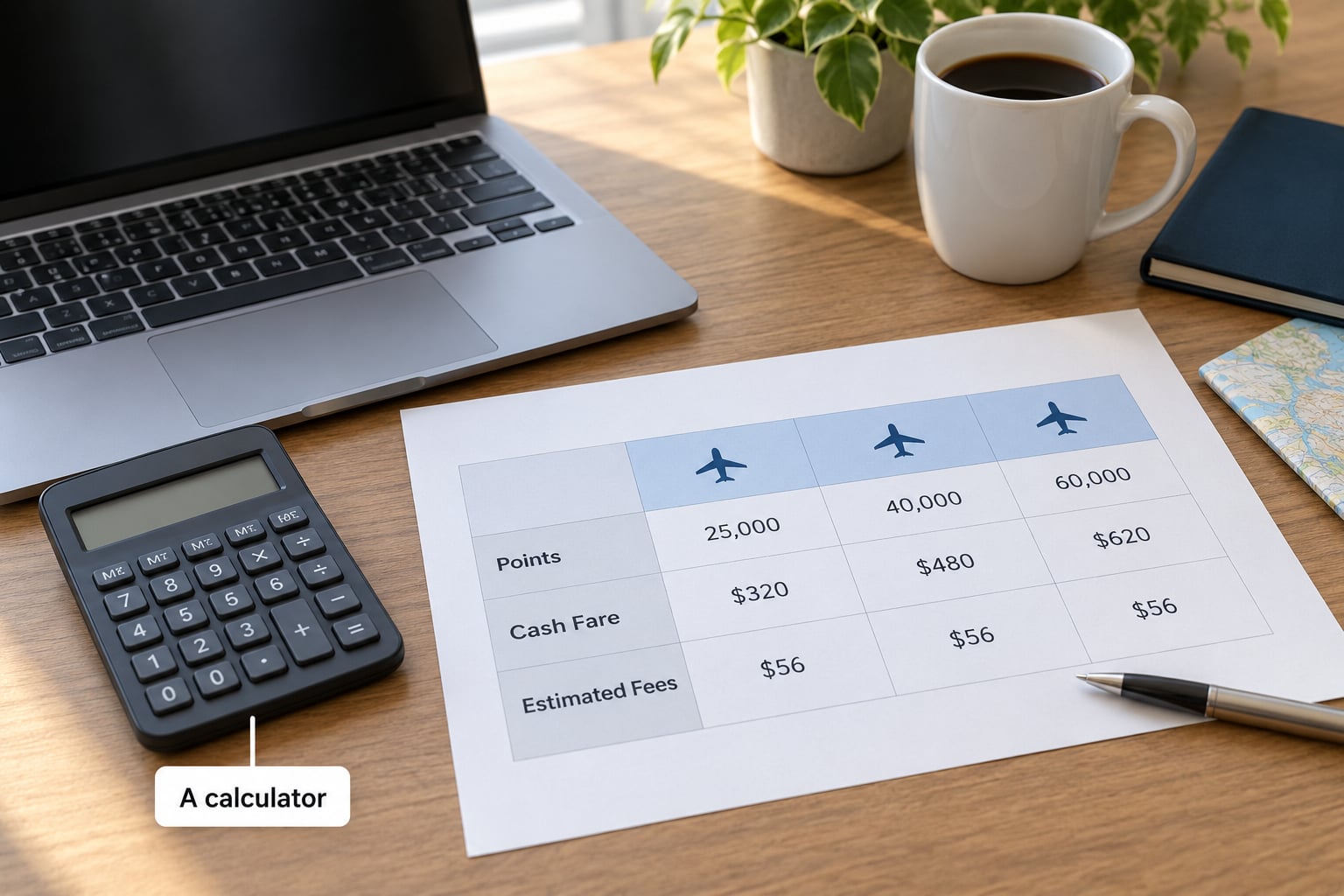
An award ticket always has a cash component, and the question is whether points cover it or merely subsidise it. Open the airline site in one tab and Google Flights in the other, and put the same itinerary in both.
Then do the arithmetic. Take the cash fare minus the unavoidable taxes, divide by the miles the award requires, and that gives you cents per point on this specific flight. A transatlantic business class redemption where the surcharge wipes out most of the value often works out well below the 1.5 cent floor that experienced redeemers treat as reasonable.
Users on r/awardtravel describe a variant of this that most guides skip: price the itinerary one leg at a time. Award pricing is set per segment, so a multi-city or open-jaw booking can come out cheaper than the round trip the airline website shows, and sometimes cheaper than booking the two halves separately.
If the award total lands far above the cash fare, the answer may be to pay cash with a points-earning card and keep your miles for a better itinerary later. That is a real strategy among points people, not a consolation prize.
Step 3: Transfer to a program that does not pass on fuel surcharges
This is the lever that produces the biggest savings, and it costs more points. You give up a higher redemption rate to escape a surcharge of several hundred dollars per passenger.
Programs commonly cited on travel forums and points blogs as absorbing or sharply reducing the fuel surcharge include Avianca LifeMiles, Air Canada Aeroplan, Alaska Mileage Plan, United MileagePlus and American AAdvantage, plus Southwest Rapid Rewards for its own metal. KrisFlyer is noted for low surcharges on many Asian routes. The list changes with fuel prices and airline policy, so verify the current treatment in the fee schedule you found in step 1 rather than trusting a list, including this one.
Two extra checks before you transfer. First, confirm your intended award is actually available in that program; phantom availability, where a seat shows in search but will not price at checkout, is common on United. Open the award booking page and confirm the miles and cash total before you move anything.
Second, watch for a separate award booking fee. Avianca LifeMiles, for example, has charged a modest fee per award booking. That fee is small next to a fuel surcharge, but it belongs in your comparison. Transfers themselves are usually free from the bank side, and the points come out of your bank account at the same moment, which is why step 6 matters.
Some program combinations also open up fare classes that carry no surcharge at all, because the fare bucket itself is different. Cheap business class fares on certain partners are the classic case.
Step 4: Book inside a low-fee redemption window
Airlines price award inventory by how close you are to departure. American Airlines and others use close-in tiers that add a fee when you redeem inside roughly three days of travel, and those fees apply on top of everything else. Book on the airline’s own site, never by phone, and you skip both.
Availability moves in waves. Award seats open about 330 to 355 days out, and a second, often better wave appears roughly 14 days before departure as schedules firm up. Searching between those waves, rather than the moment you decide to travel, is the cheapest thing you can do.
Watch for short promotional fee waivers, which several programs run on new account openings or partner anniversaries. Treat them as a bonus rather than a plan. One detail worth checking during a waiver: redemption fees are often waived on the lowest cabin only, and the waiver can end before your travel date, which leaves you exposed if you book too far ahead.
Step 5: Avoid the extra charges that come from how you pay and where you book
Separate the costs you cannot avoid from the ones you chose. Government taxes and airport charges are mandatory. Almost everything else on this list is optional behaviour.
- Card surcharges. Paying with a card your airline dislikes can add several dollars per booking, per passenger, per direction. Check the accepted payment methods on the airline’s site and use one of those.
- Third-party booking sites. Online travel agencies add their own convenience fee, and their award search tools frequently do not show the surcharge at all. Book award travel directly with the airline.
- Separate bag fees. Award tickets often come with fewer free bags than cash fares, or none in premium cabins. Check the allowance before you commit.
- One booking per segment. Several small transactions can mean paying the per-booking charges repeatedly. Consolidate where the fare rules allow it.
- Seat and service fees. These sit outside the ticket price entirely, so build them into your real total before comparing against cash.
The travel-credit angle is worth adding to that list. Several premium cards issue a statement credit for travel purchases, which can offset part of the unavoidable tax bill on an award booking. The mechanics vary by card, so read your own benefit terms rather than a generic blog post.
Step 6: Confirm the total on screen before you pay
This is the three-minute checklist. Run it every time.
- Itinerary. Dates, times, airports, connection lengths, and the operating carrier on every segment. Look for a codeshare operated by a partner, because the operating carrier sets the surcharge.
- Names. Exactly as typed into your passport or ID. A name correction later can cost more than the fee you were trying to avoid.
- Points. The number of miles about to leave your account, per passenger and in total.
- Cash total. Broken into taxes and fees, carrier surcharge if any, and any booking fee. If a surcharge line appears and your program should absorb it, stop and check.
- Baggage. How many bags per passenger, per segment, and on which carrier.
- Change and cancellation terms. Read them before you pay, not after. On partner airlines they are often far stricter than the marketing page suggests.
If anything looks wrong, close the tab and start again rather than forcing it through the phone. That detour is exactly the situation where a quick call to the airline produces a waiver, since agents can often remove fees the website will not, and some will hold an award reservation for a limited time while you arrange payment.
Step 7: Save the record and track the booking
Screenshot the fare breakdown and the checkout total, then save the confirmation email in a folder you will actually search later. Write down the miles debited, the cash charged, and the date. Add a calendar reminder for any free-cancellation or free-change window that the fare rules give you, and set a second one roughly a week before that deadline.
Track two things after booking. The award price itself, in case the airline lowers it and refunds the difference as miles or points. And your own fee comparison, so you learn which program was cheapest for which route this time. A year of those notes turns you into someone who knows their own break-even point rather than guessing at every checkout.
Common Mistakes That Raise the Bill
Booking through a third-party site. Aggregators rarely display the carrier surcharge and always add their own convenience fee. The saving is small and the cost is a fare you cannot see until you are already committed.
Using a fare found days earlier. Award availability and surcharges both move. A price you looked at last week may no longer exist, and the cash component changes with it. Re-check on the day you commit.
Confusing taxes with avoidable fees. This is the most expensive mistake. Someone sees a large cash total, assumes it is all fees, and abandons a good redemption when half of that amount is income tax they would have paid on a cash ticket too. Only the surcharge and the booking fees are in play.
Waiting for a sale that does not exist for awards. Award pricing does not follow cash sale cycles the way people expect. The lever is timing relative to inventory release and close-in tiers, not seasonal discounts.
Splitting one itinerary into several bookings. Booking each leg alone can double per-booking charges and lock in separate change and cancellation terms, which turns one flexible ticket into several rigid ones. Compare the totals before you do it.
Ignoring partner change fees until you need them. Award tickets booked on partner carriers often carry change fees of several hundred dollars, and those fees land later. If the change terms rule out the trip you are actually planning, book something else.
Transferring points before confirming availability. Transfers are one-way. Check the award is bookable at the miles and cash total you expect, then transfer, then book the same day.
Frequently Asked Questions
What are the fees and surcharges included in an award flight ticket?
An award ticket carries four cost types: government taxes and airport charges such as income tax and Air Passenger Duty, which are unavoidable; the carrier-imposed fuel surcharge shown as YQ or YR, which the loyalty program may or may not pass on; airline booking fees including close-in tiers and phone or agent surcharges; and change or cancellation fees that apply later. Only the surcharge and booking fees are usually within your control.
How can I avoid fuel surcharges on an award booking?
Transfer your points to a program that does not pass on the carrier surcharge, even though it charges more miles. Programs such as Avianca LifeMiles, Air Canada Aeroplan, Alaska Mileage Plan, United MileagePlus and AAdvantage are often cited for absorbing it. Also consider departing from a country that regulates surcharges, and check the fare breakdown in ITA Matrix for the YQ or YR line before you commit.
Can airlines add a fuel surcharge to a flight I already booked?
Yes, on many tickets. In the US and much of the world the surcharge is added at ticketing and sits in the final total, so it arrives before you pay rather than after. Some carriers and some markets allow a surcharge to be applied later to an existing booking, and any change can trigger a fare recalculation. Read the surcharge clause on your confirmation and check before assuming the amount is fixed.
How do I avoid a close-in booking fee and a phone booking fee?
Book online instead of calling, and book well ahead of departure. American Airlines and other carriers add a fee when you redeem inside roughly three days of travel, and phone or agent bookings often carry their own per-passenger charge. If the website will not let you complete a booking you are entitled to, calling and saying so is a well-known way to get the fee removed, and agents can hold an award while you sort out payment.
Is the booking fee refundable if I cancel an award reservation?
It depends on when you cancel. Most programs return the miles in full if you cancel before departure, but some charge a redeposit fee or apply a small cancellation charge, and points-based fees are not refunded. Cancel well before the free-cancellation deadline listed in the fare rules. Once you cancel, redeeming the same itinerary again may cost different miles and a different cash total, so check before you rebuild it.
Why does an award ticket cost so much in taxes and fees?
Because award travelers pay government taxes and carrier surcharges on top of the miles. Long-haul premium cabins attract heavy income tax, and a fuel surcharge that a cash fare would absorb can be charged in full to someone paying with points. A single transatlantic business class award can carry several hundred dollars per person in cash. The fix is choosing the program and route, not waiting for a discount.
Conclusion
Start with the official fee schedule for the program you are eyeing, then compare the full award total against the cash fare for the same flight. If the cash side is mostly unavoidable tax, transfer to a program that does not pass on the fuel surcharge, book online well ahead of departure, and confirm the total on screen before you pay.
How to avoid award booking fees is mostly a sequence, not a trick: pick the program first, check the surcharge, then book. Do those three things and most of the cash that shocks people never appears.