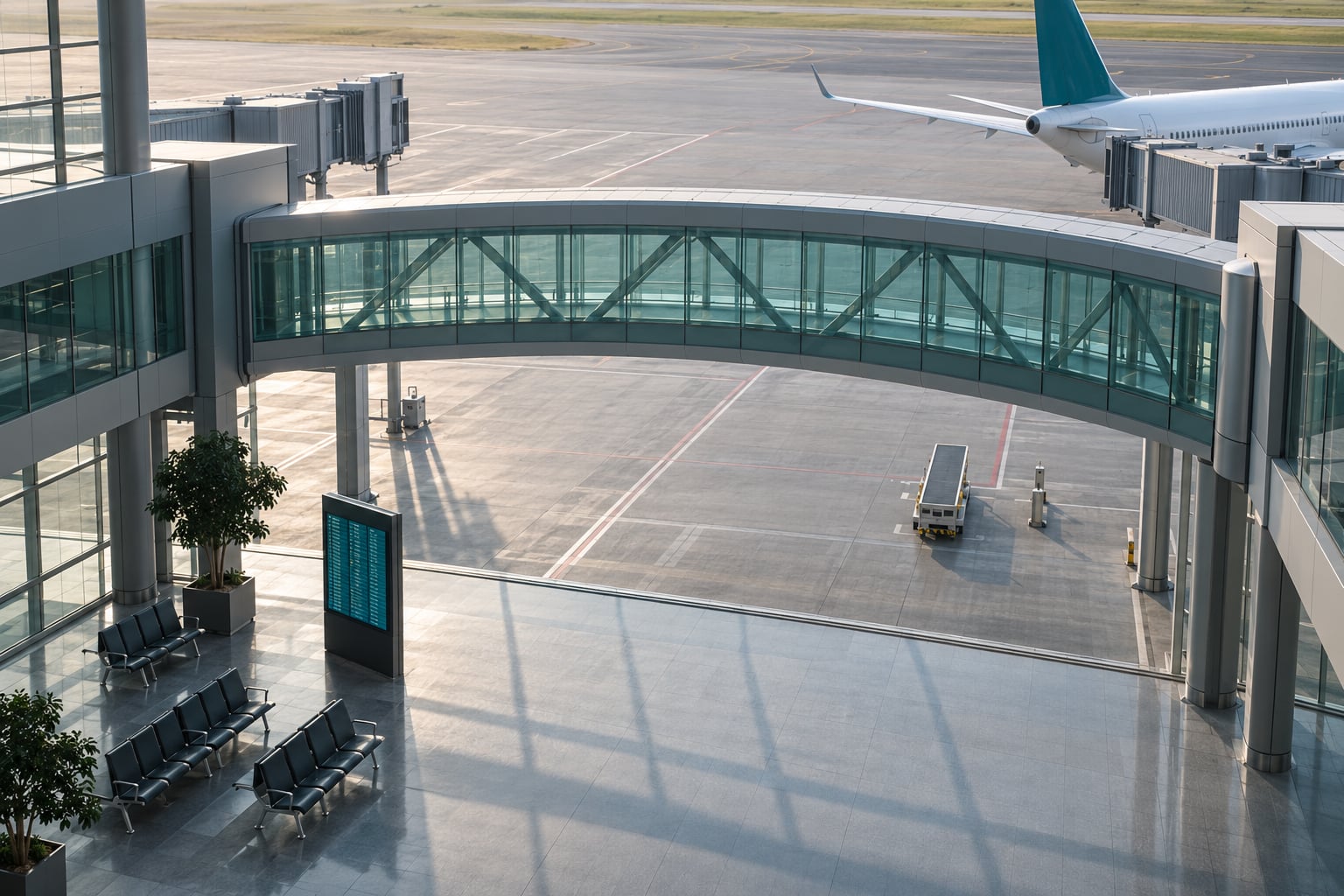
Airport transit without a visa works when your connection stays inside the airport’s secure transit zone: you clear the departure airport’s security, pass through a restricted area, and board your onward flight without clearing immigration in the country you are crossing. Whether that is allowed depends on your passport, the route, the airports, and whether you ever cross into a public area.
That last clause is the whole thing. Millions of connecting passengers move between gates every day without any visa at all, and millions of others get stopped at check-in for exactly the same itinerary shape. The difference is rarely the length of the layover. It is whether border control ever sees you.
Last reviewed 2026. Transit rules change with little notice, so treat everything below as a framework and verify your own itinerary with official sources before you pay for anything.
Table of Contents
- 1How Airport Transit Without a Visa Works
- 2What Airport Transit Without a Visa Actually Means
- 3Airside Transit vs. Entering the Country
- 4When Does Visa-Free Airport Transit Apply?
- 5Do You Need a Visa to Transit or Change Airports?
- 6Domestic vs. International Airport Connections
- 7What Documents and Details Should You Check?
- 8What Happens During an Airside Connection?
- 9Can You Leave the Secure Area During a Transit?
- 10What Can Make a Transit Easier or More Difficult?
- 11How to Check the Rules Before You Travel
- 12Frequently Asked Questions
- 13Can I pass through an airport without a visa if I am only changing flights?
- 14Does a short layover automatically qualify for visa-free airport transit?
- 15Do I need a visa if my international connection requires me to collect my checked bag?
- 16Can I stay overnight at the connecting airport without entering the country?
- 17What happens if my transit is at a different airport or on a separate ticket?
- 18Who should I contact if the airline says I am not eligible for transit?
- 19Conclusion
How Airport Transit Without a Visa Works
Transit is treated differently from entry because the passenger is not staying. Border authorities assume you will board the same day’s onward flight, and most countries grant a short, no-visa passage through the international transit area to travellers who never leave it. When that assumption breaks, the rules break with it.
The system is not one global rule. Each country publishes its own list of nationalities that must hold a permit to pass through, and each airport builds its own physical layout around whether it can keep connecting passengers airside. The same passport can be fine at one hub and require a visa at another ninety minutes away.
A transit permission lets you pass through. It does not let you enter the country. If you need to collect a checked bag, change airports, pass immigration, or stay overnight, you have asked for something no transit arrangement covers, and a full visa comes into play.
What Airport Transit Without a Visa Actually Means
Concretely, airport transit without a visa means four things happen and one thing does not. You are screened before departure at your origin. You wait in a restricted or sterile area that ordinary arriving passengers do not use. You pass any transfer security screening the airport requires after the arrival. And you board onward from that same restricted area.
What does not happen is passport control or an entry stamp. No immigration officer sees you, which is the entire mechanism.
Airside Transit vs. Entering the Country
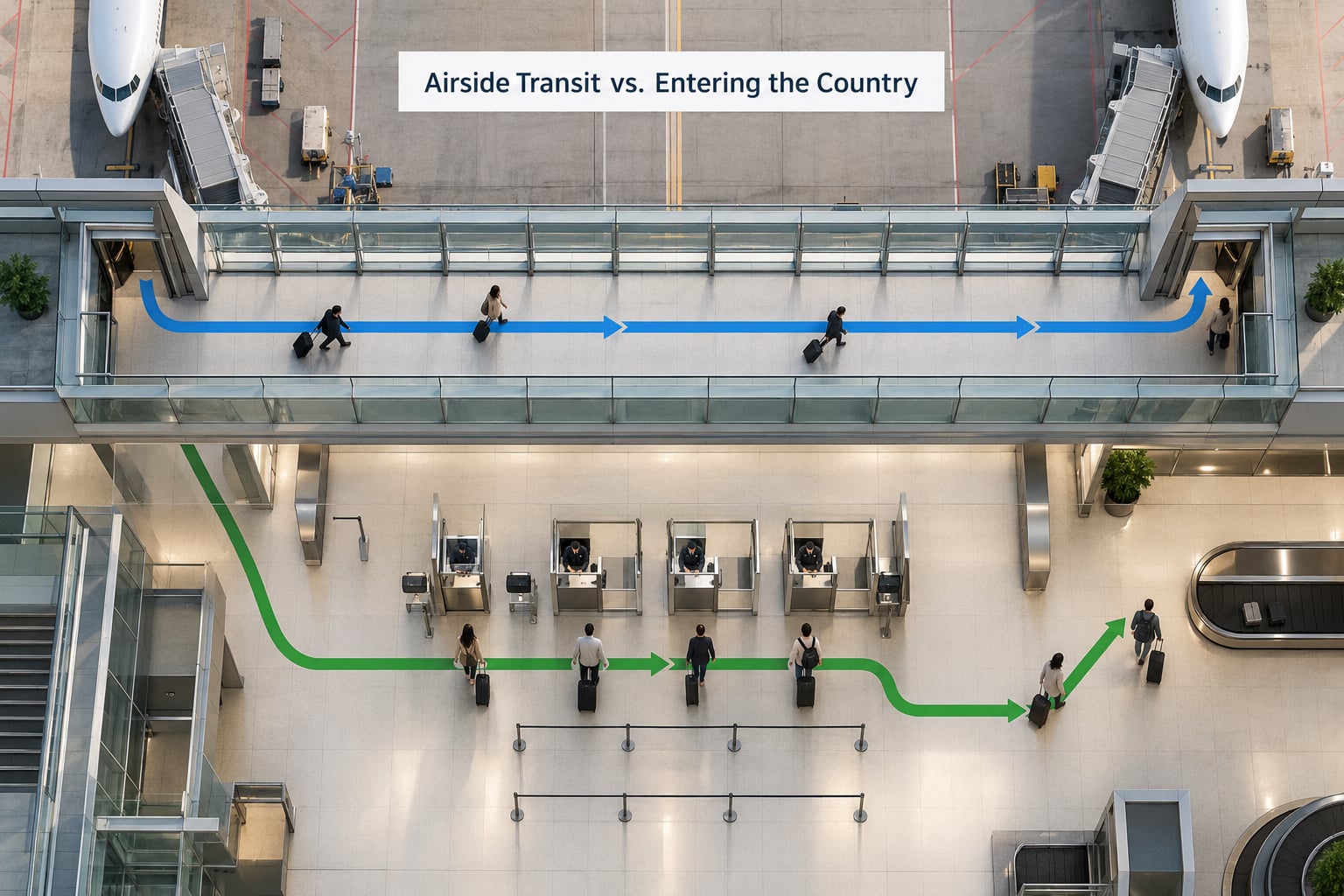
Airside and landside sound technical, but the test is simple: does the route take you past an immigration desk? Airside stays in the secure zone. Landside takes you through arrivals, past border control, into the public hall.
| What you do | Airside transit | Entering the country |
|---|---|---|
| Pass immigration | No | Yes |
| Get an entry stamp or visa stamp | No | Yes |
| Collect checked bags | No | Usually yes |
| Reach shops, food or hotels landside | No | Yes |
| Pass customs | No | Yes |
| Visa needed if nationality is listed | Often a transit visa only | Full visitor visa |
| Usual risk | Routed to a transfer desk or escorted landside | Refused entry at the border |
Two practical consequences follow. First, a landside transfer is not a small inconvenience, it is a different legal situation: the moment you pass the arrival corridor, you are asking to be admitted, and a transit permit usually does not cover that. Second, the same-ticket structure matters. On a single ticket the airline is responsible for getting you onward, so it will usually hold you at the transfer desk. On two separate tickets nobody is holding anything.
Forums describe this as the single most repeated mental model among travellers: stay airside and almost nothing is required. Travellers on the KLM forum say routing on one KLM ticket through Heathrow avoids UK transit paperwork precisely because border control never happens. It is the correct model, with one caveat below.
When Does Visa-Free Airport Transit Apply?
Authorities look at a combination of factors, and any one of them can turn an easy transit into a visa problem.
- Citizenship. The list of passports required to hold a transit permit is published by each country. If yours is on it, a permit is required unless an exemption applies.
- Destination and route. The same passport can need a permit for one routing and none for another, because the permit is issued by the country of transit, not your destination.
- Airport and terminal. Some hubs can move you between terminals airside. Others run a landside corridor where everyone passes border control.
- Connection length. Most countries cap how long you may stay in the transit area, commonly somewhere between a few hours and a day or two. An overnight wait can fall outside the window.
- Ticket type. Separate bookings break the protected connection and often force landside transfer and bag re-check.
- Baggage status. A bag tagged to your final destination supports an airside transit. A bag tagged to the transit country usually does not.
- Passport validity and onward ticket. Most schemes expect a passport valid beyond your stay and proof of onward travel.
No universal rule covers all of this. Check the transit country’s official immigration or foreign affairs page for the country whose airport you are using, and check it again close to departure.
Do You Need a Visa to Transit or Change Airports?
A same-airport, airside connection on one ticket is the case most transit permissions are designed for. Changing airports is different. A separate city, a separate airport code, or a terminal change that routes you through the public arrivals hall means you pass immigration, and passing immigration means you need permission to be in the country, not just permission to cross it.
Collecting a checked bag does the same thing in a different way. Bags are collected in the arrivals hall, and the arrivals hall is landside.
Domestic vs. International Airport Connections
Why does one connection need nothing and another need a permit? Because the control point is the border, and a domestic connection may never cross one.
Inside a single country’s airspace, a connecting passenger often goes from one gate to another through a corridor with no immigration desk at all. Some large airports route even domestic transfers through a screening checkpoint and a landside hall for security reasons, but no border control applies, so no transit permit is relevant.
International connections are different by design. Arriving from another country means landing at a border, and border control sits at the arrival point of international flights even for passengers who are only changing planes. That control is exactly what a transit visa or transit-free scheme is designed to bypass, or to authorise cheaply when it cannot be bypassed.
Health screening can also appear on international routes, and customs declarations attach to the arrival side rather than the transfer side. None of that changes the core rule: the border is what you are being kept away from.
What Documents and Details Should You Check?
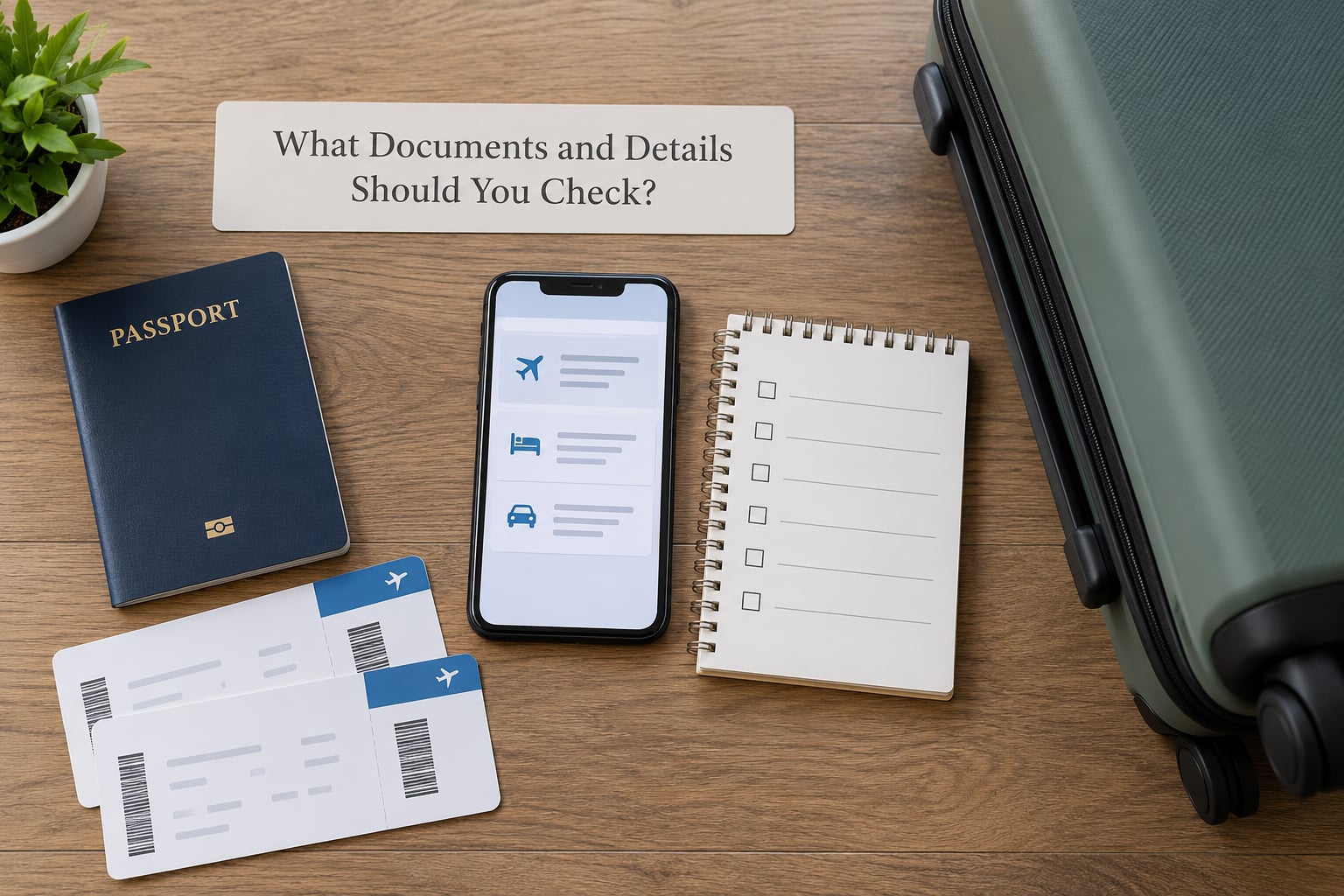
Work through this list before you book, and again a week before you fly.
- Passport validity. Many transit schemes want at least six months beyond the date you leave the transit country. Check the issuing country’s own rule too.
- Onward ticket. Proof of onward travel is commonly required to show you intend to leave.
- One ticket or several. Confirm whether both flights are on a single booking reference. If not, assume landside transfer.
- Where your bags are tagged. If they are tagged to your final destination, say so to any staff who ask, because it supports the airside route.
- Airport and terminal for both flights. A terminal change is the single most common hidden trigger.
- Arrival time of the first flight and the connection duration. Long waits can exceed the permitted transit window.
- Whether your passport appears on the transit country’s list. Then check whether an exemption applies to you.
- Notification rules. Some airports require you to declare a transit online before arrival, or to hold a specific document format.
- The rules of every country whose airport you use. An itinerary with two transit countries can need two separate answers.
What Happens During an Airside Connection?
The mechanics are more predictable than most travellers expect, and the physical layout explains most of the variation between airports.
- You land and follow transfer signs. Not the exit signs. Connecting passengers are directed to a corridor, a bus gate or a transfer desk depending on the airport’s layout.
- You stay in the restricted area. At many large hubs this is a long corridor with seating, toilets and sometimes a small transfer lounge.
- You move between terminals if needed. Some airports walk you through a dedicated airside connector. Others run airside buses for long distances. A few send connecting traffic through landside, and at those you pass border control and the transit question becomes an entry question.
- You may be re-screened. Transfers that cross a security boundary require passing security again, and queues can eat a short connection.
- You pass a transfer document check. Many airports scan or inspect your passport again even though no immigration decision is made, and some route passengers who do not clearly qualify to a staffed transfer desk.
- You board. Gates can change, so keep checking the departure screens rather than trusting the first board printed at landing.
If you are moved to a transfer desk or escorted to a public area, it is usually because staff could not confirm you were entitled to an airside transit. Answer their questions directly and ask for the airline representative if you are on a single ticket.
Can You Leave the Secure Area During a Transit?
Leaving the secure area generally ends the airside arrangement, because you have passed into the public part of the country. On a visa-free transit you would normally need a full visa to be there. Some airports run short-stay transit programmes that allow a defined period landside, and some allow re-entry for a limited window after re-screening, but both are exceptions tied to a specific airport and a specific passport.
For an overnight layover, options are usually a transit hotel inside the secure zone, a lounge with sleeping pods, or a long enough time in the transit area to be allowed to stay. Which one applies depends on the airport’s published rules.
What Can Make a Transit Easier or More Difficult?
Some conditions make a connection routine and others make it a project. These are the ones that actually bite.
- Short connections. Under an hour at a hub where transfers are walked rather than bussed is tight once re-screening is included.
- Separate tickets. A self-transfer means you clear the terminal on your own, re-check any bag, and pass security again. It also means the second airline is not obliged to help you when something goes wrong.
- Overnight waits. They can exceed the permitted transit window, and they often tempt travellers toward the exit.
- Checked baggage on separate tickets. Bag collection is landside, so a self-transfer with a bag almost always requires a visa.
- Terminal changes. Large hubs built as separate buildings often route transfers landside by default.
- Passport-control staffing. During busy periods, transfer checks slow down and connection times get tighter.
- Airport closures or operational rerouting. A closure at your scheduled hub can push you onto a routing your transit permission does not cover.
There is one more factor travellers underestimate. The airline may need permission to transport you at all. Because the carrier carries the financial liability if you cannot be admitted, they verify transit documentation before departure, not on arrival. Forum reports of a boarding pass issued and then a transit document refused at the gate are common, and the check happens at your origin.
How to Check the Rules Before You Travel
Three checks cover almost every case, and they should agree. Where they disagree, the official authority and the airline’s own system win.
- Run your exact itinerary in the airline’s or IATA’s entry requirement lookup. Airlines use the same entry requirement data their agents and check-in systems use, and it accounts for your passport, routing, airport change and ticket type. This is the check that matches what will happen at the gate.
- Read the transit country’s official immigration or foreign affairs page for your passport. This is the legal position and the place where exemptions are listed.
- Ask the operating airline, not only the booking site. The operating carrier knows its own terminal layout and bus arrangements, and it is the party that would deny boarding.
Run the airline check before you buy, since a routing change can change the answer. Run all three again a week out, because rules and even national lists get amended. Avoid treating a blog post, a search snippet or an AI assistant as the answer; travellers report both AI tools and airline pages confidently stating the opposite of the official guidance.
Frequently Asked Questions
Can I pass through an airport without a visa if I am only changing flights?
Usually yes, provided you stay inside the international transit area and your passport is not on that country’s transit visa list. The rule applies to short connections as readily as long ones. It stops applying the moment you pass immigration, collect a checked bag, change airports or stay past the permitted transit window. Verify with the operating airline and the transit country’s immigration authority.
Does a short layover automatically qualify for visa-free airport transit?
No. Length alone decides nothing. What matters is whether you remain in the secure transit zone, whether your nationality requires a permit, and whether the airport can route you airside. Some countries grant visa-free transit only within a maximum number of hours, and many airports require a transfer security screening even for a two-hour connection.
Do I need a visa if my international connection requires me to collect my checked bag?
Yes, in almost every case. Bags are collected in the arrivals hall, which is landside, and collecting them means passing immigration. Transit permits authorise passage through the airport, not entry into the country. The exception is a bag tagged straight through to your final destination on a single ticket, which normally lets you stay airside.
Can I stay overnight at the connecting airport without entering the country?
Sometimes. You can remain in the transit area for an overnight connection only if your nationality is not listed and the airport allows a stay that long, since many countries cap transit time well below 24 hours. Some airports also run in-terminal hotels or lounges with sleeping pods. Check the airport’s published rules for your specific terminal.
What happens if my transit is at a different airport or on a separate ticket?
Expect to clear immigration and pass through the public area, because a change of airport or a self-transfer normally breaks the protected connection. Two separate tickets make this worse, because you must collect any bag, exit secure areas and re-enter security on your own. Plan on needing a full visa unless the transit country confirms otherwise in writing.
Who should I contact if the airline says I am not eligible for transit?
Start with the operating carrier, since it decides boarding and can tell you what document or exemption it expects. Then check the transit country’s official immigration or foreign affairs page for your passport. If you hold a visa that may exempt you, ask the airline to confirm in writing. Keep the reply, since a denied boarding dispute is easier with evidence.
Conclusion
Start with two questions about your own itinerary: is the connection domestic or international, and does it happen entirely inside one airport’s controlled area without collecting bags. If the answer to both is comfortable, airport transit without a visa is likely a formality. If either is uncertain, run the itinerary through the operating airline’s entry requirement lookup and the transit country’s official immigration page before you book, then repeat the check a week before departure.